Archive for the ‘Miniatures’ Category
Ran a playtest of Advanced Song of Blades.
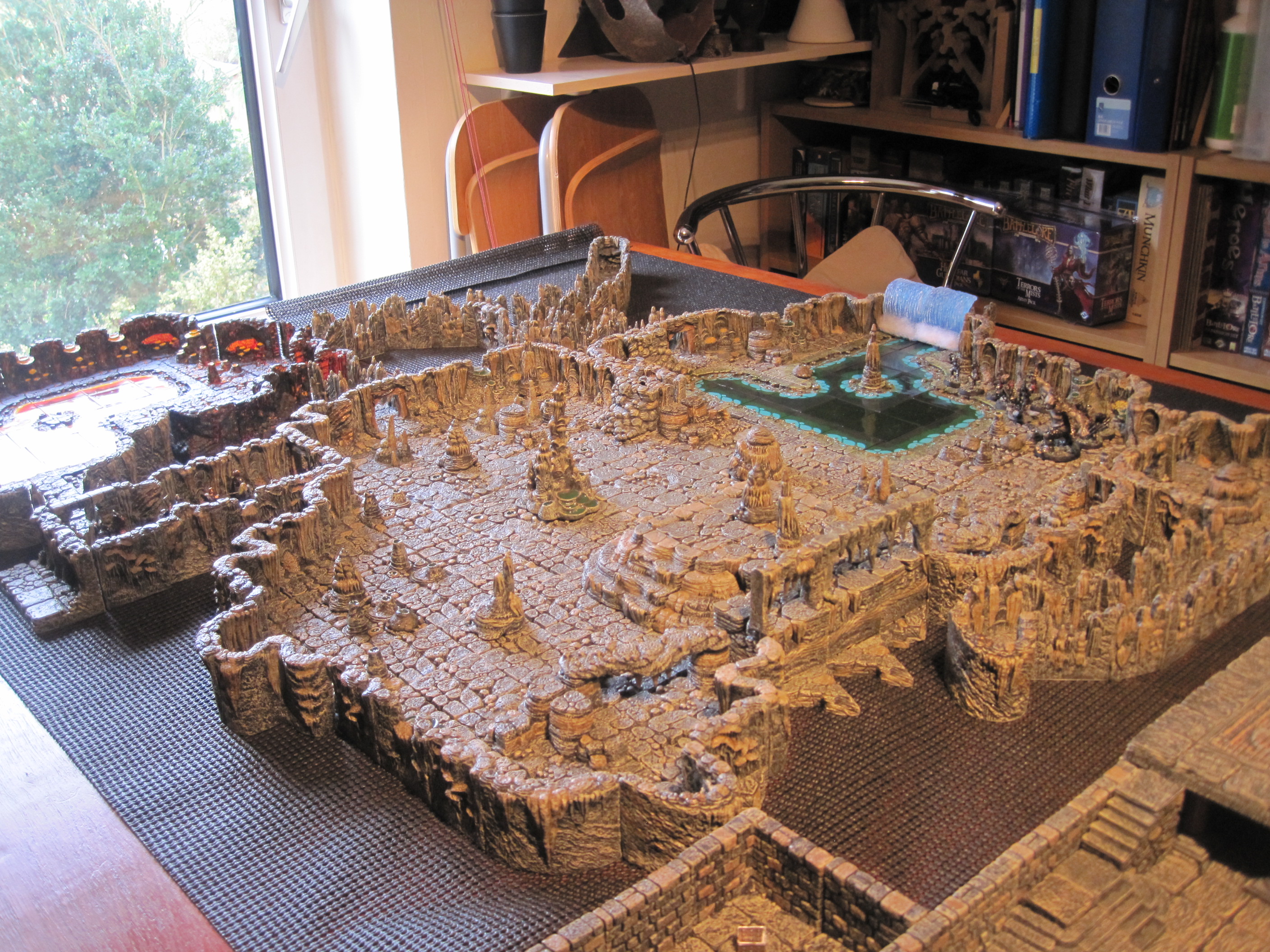
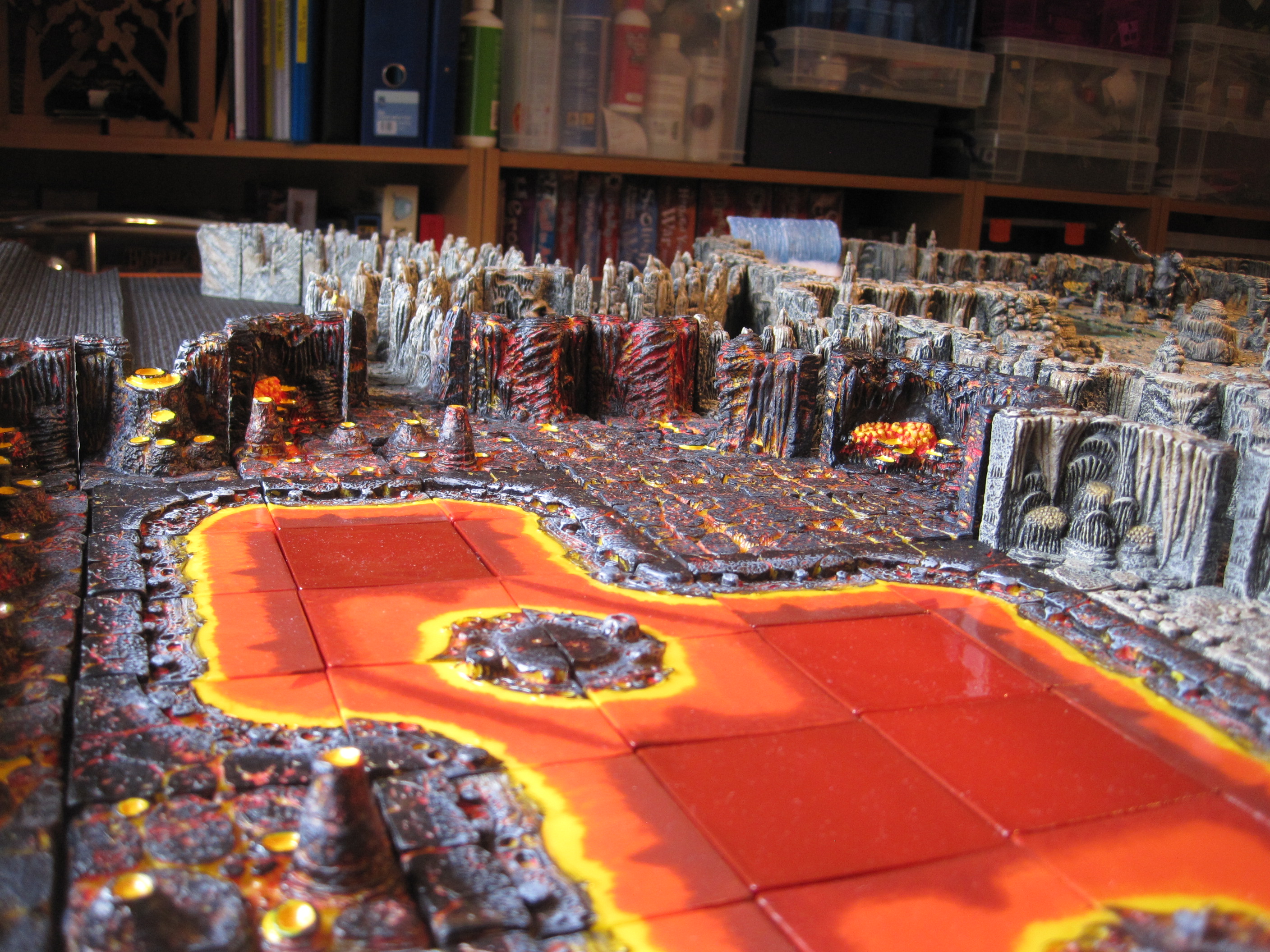
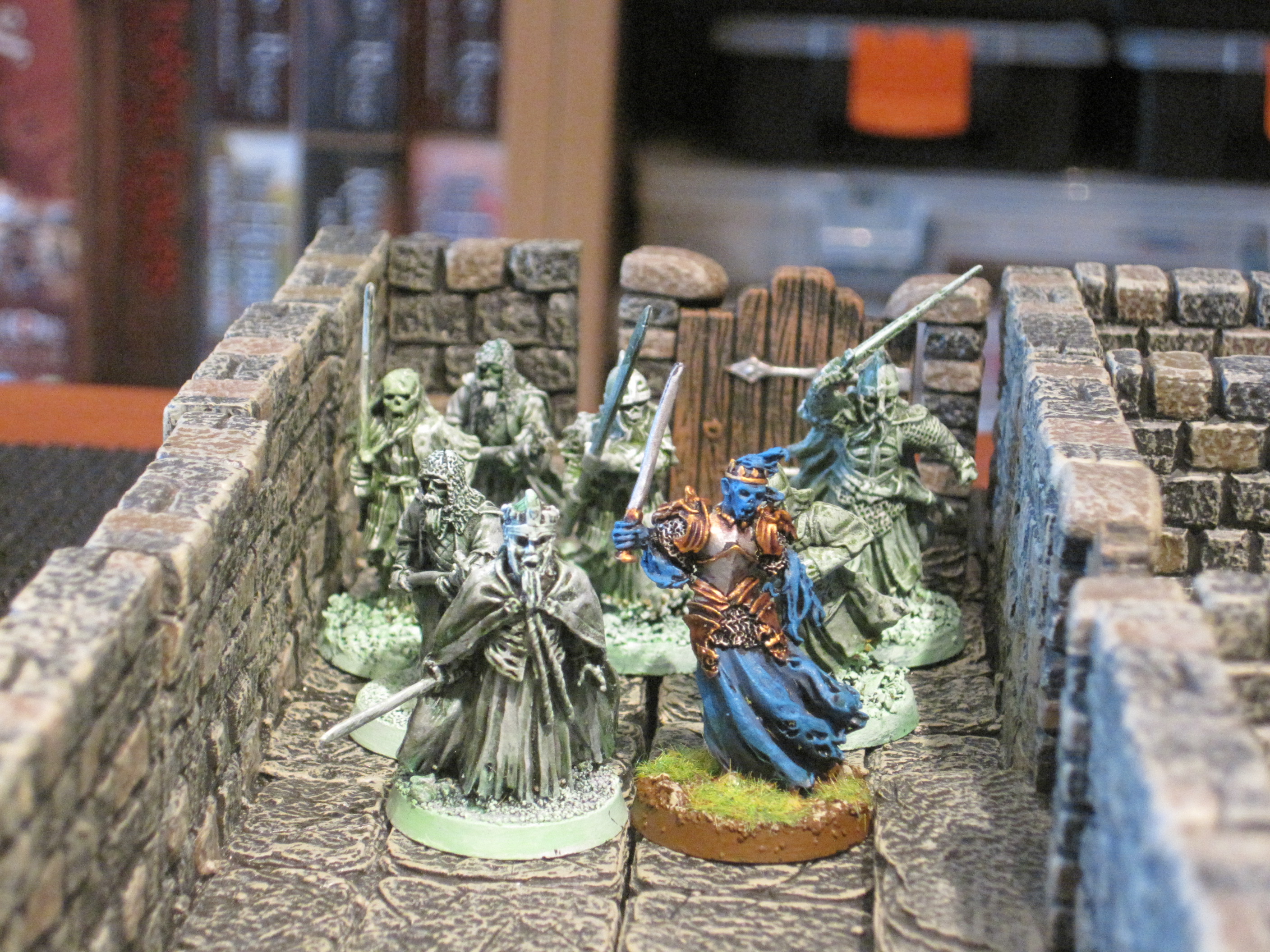
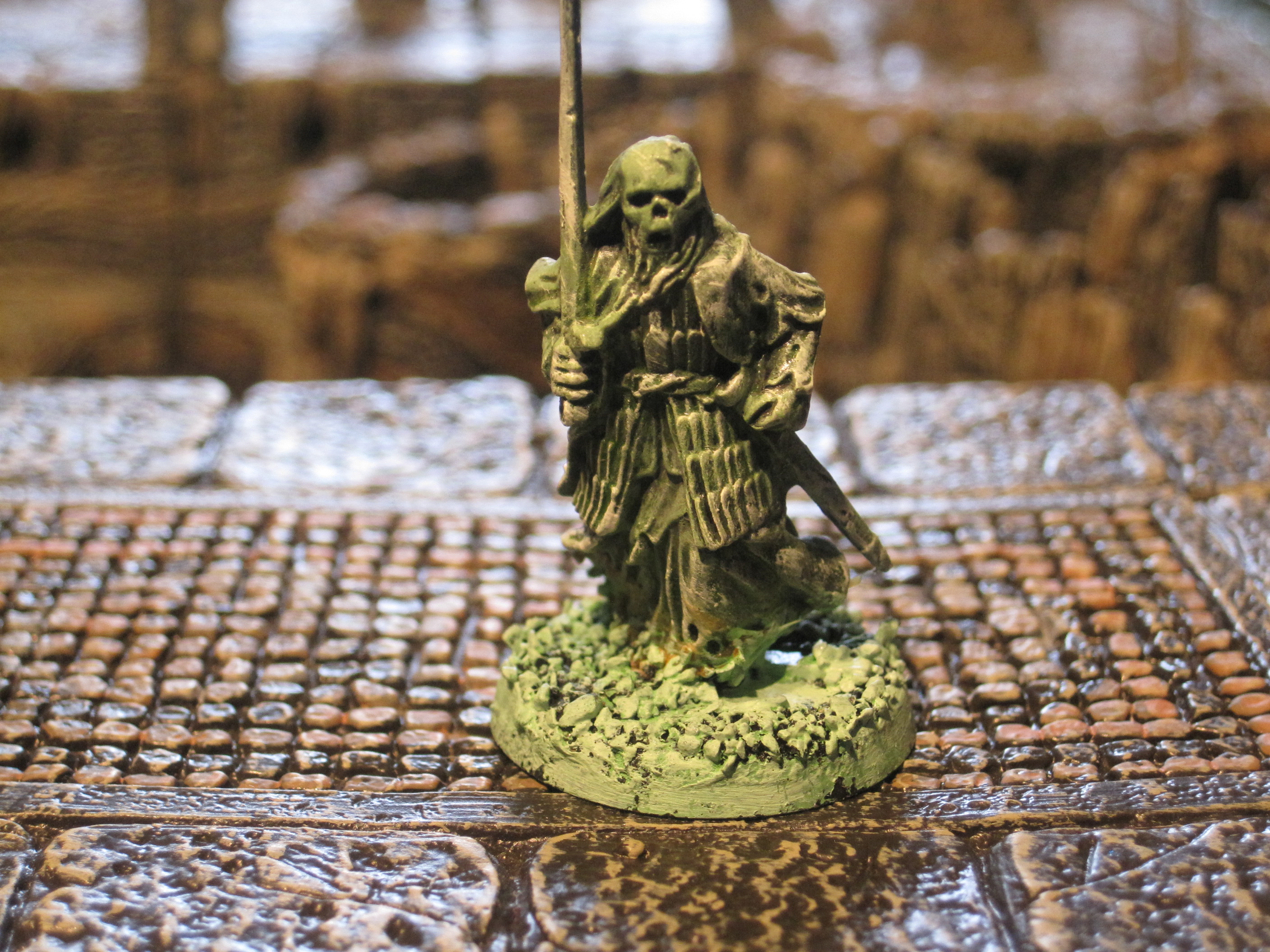
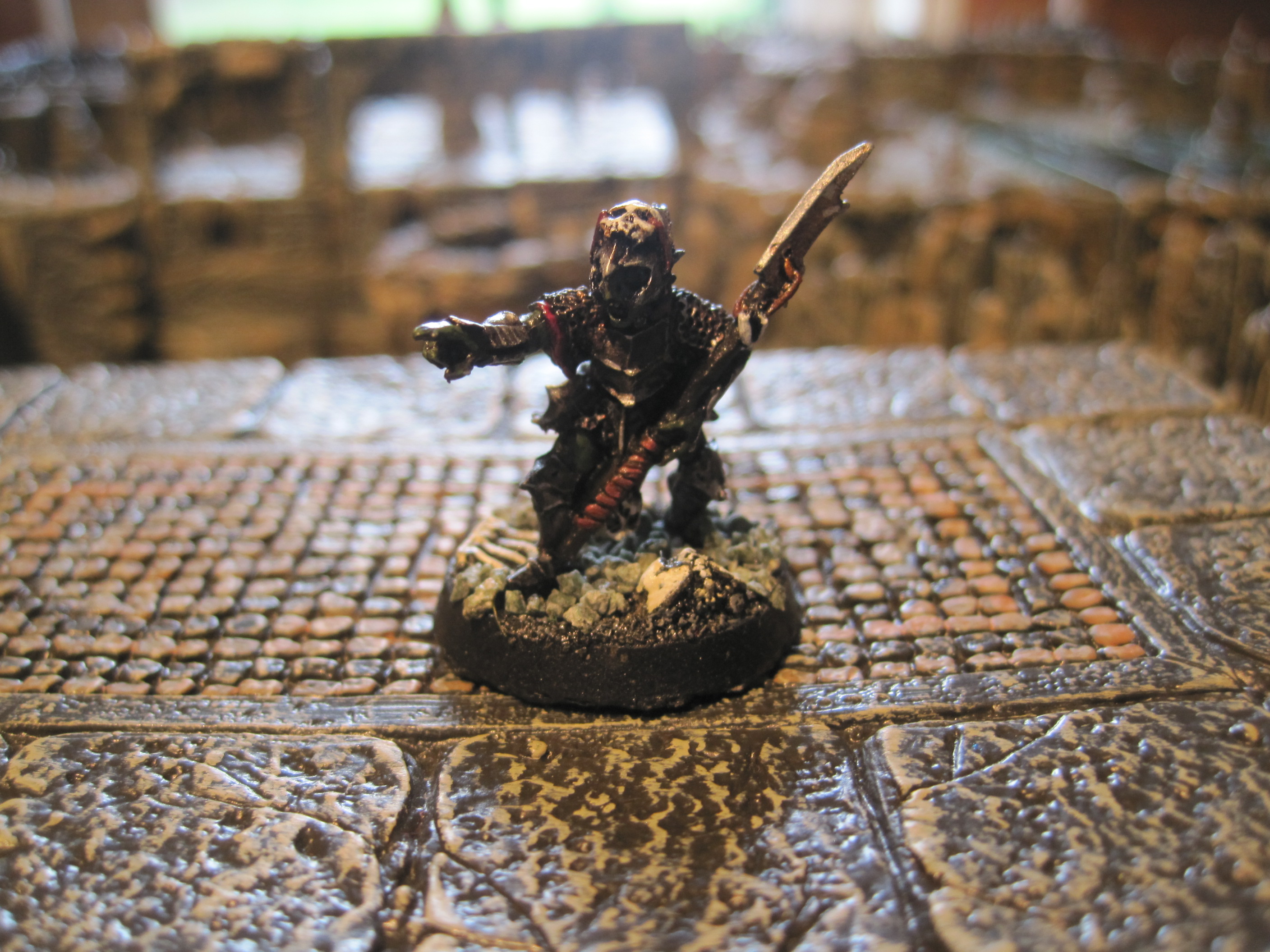
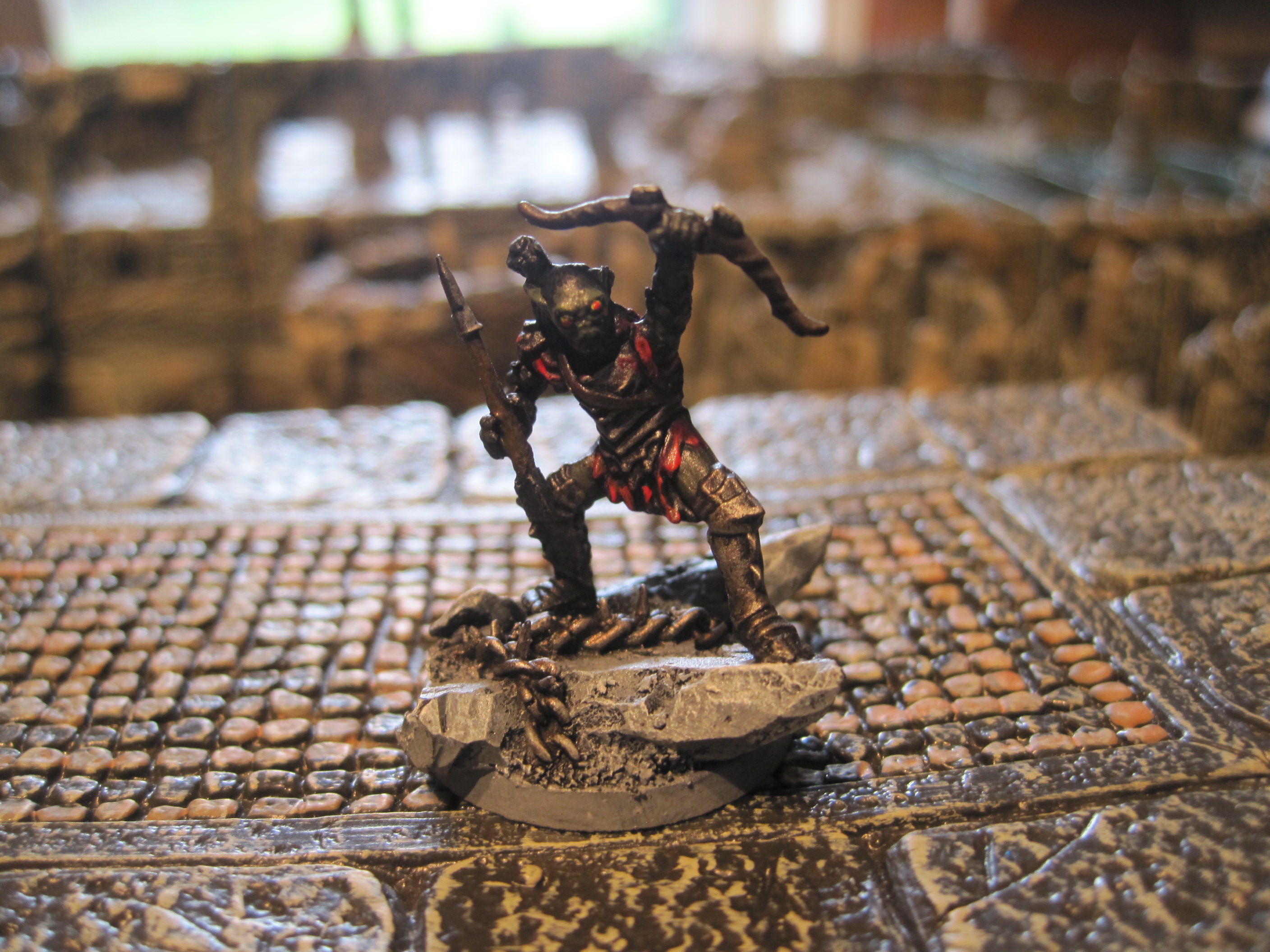
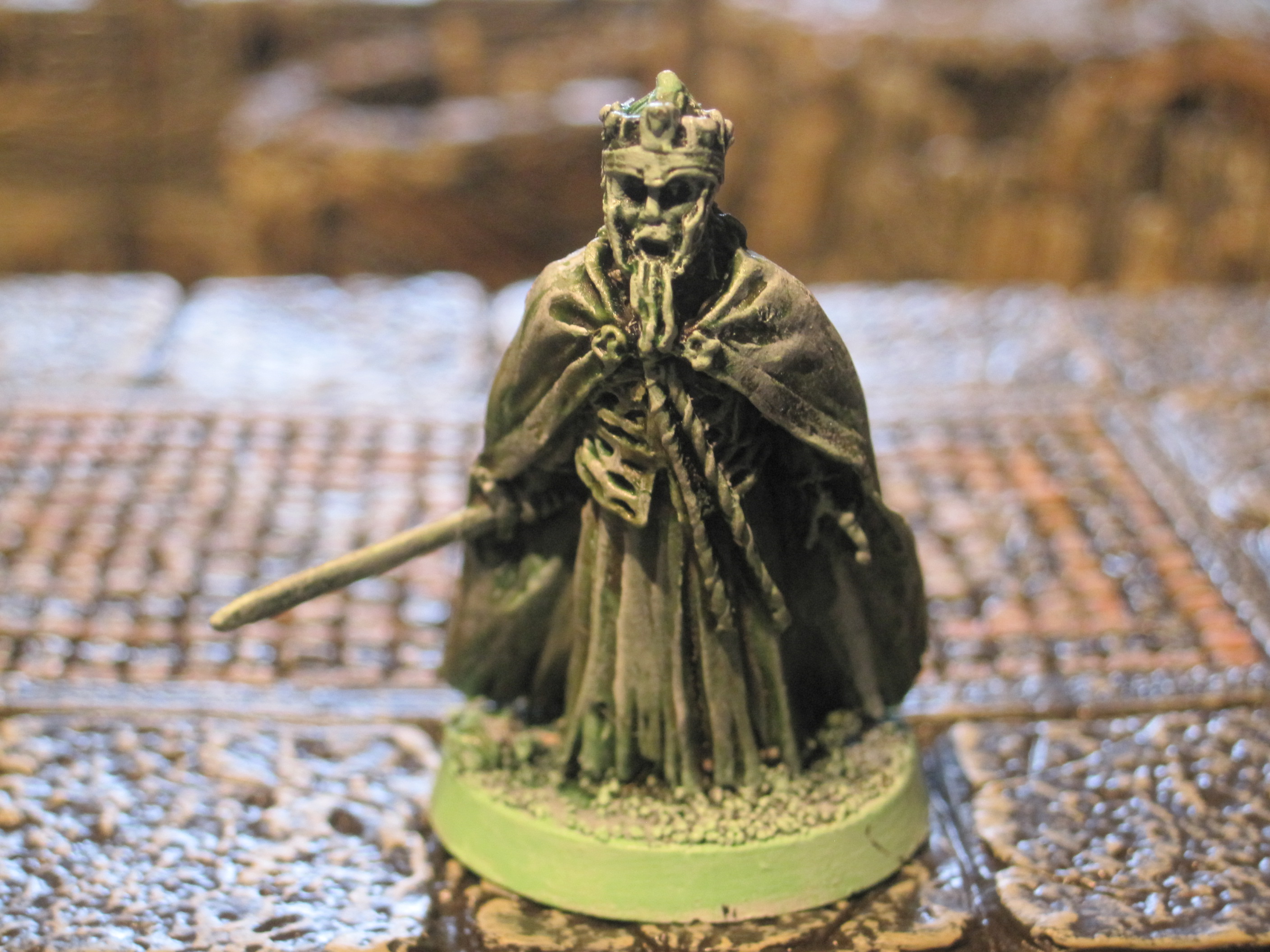
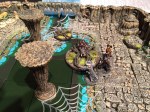
The rules are updated from the original and are indeed Advanced. See post below for pictures of the terrain and figures.
First scenario
My first game involved the company of dwarves taking on the Undead. The profiles were mainly taken from the Hammer and Forge supplement. It was interesting to see how the two different types of leaders worked once I got the rules straight which took a little time.
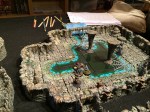
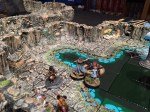
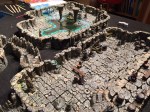
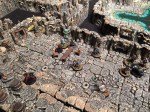
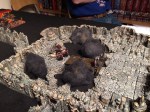
The scenario was a Treasure Hunt with 3 treasure locations based on the map which was set up as the old Fortresses ground floor with a large feasting hall or audience chamber in the centre with a smaller raised platform within and then several rooms surrounding this. One of the Treasure locations would contain a valuable chest of gems and artefacts which each side was searching for. Either defeat the enemy or take it back to their baseline which would end the scenario and then VPs would be calculated. The dwarves were searching for gemstones and a map rumoured to be inscribed upon a large crystal. The Undead had been instructed/ impelled to stop them by their Lich Lord.
The Company advanced rapidly into the main hall and the thief headed towards the dais or platform. The Undead moved more slowly towards the Hall opening the doors but not entering whilst the Wight adanced quickly also towards the dais. The Thief reached the top of the dais first but was unable to cause any damage through sling shots at the advancing Wight. The Dwarves decided to advance towards the Undead in a line with their leader in support. The Undead formed up to meet them and then both sides stood and faced each other for a split second. The Wight charged the unfortunate Thief with incredible speed. Hoping to disengage the Thief attacked but suffered a terrible wound, falling to the ground out of action.
The Undead charged led by their Leader (lead from the front) and supported by the spear armed Undead warrior. They managed to force the Dwarves into combat and then were able to push their advantage subsequently. The Leader moved forwards to assist a downed colleague but was struck down mortally wounded in turn. This caused consternation amongst the dwarves who were already hard pressed in combat. Soon they were down to half their original strength and a further morale roll sealed their fate. The Wight picked up the treasure finding it on the first attempt and the Undead claimed a Major Victory.
I learnt about the two different types of leaders and how the new Lead from the front is useful when the lines are closing for battle. The other form of leader is still useful especially with his quality bonus but he can be left out of position when the lines close plus he cannot React with his groups during the opponent’s turn. The Reaction rules certainly added a great deal. It made moving low Q troops like the Healer harder and it gave good Q troops like the well led dwarves very quick on the battlefield despite their short legs. The biggest difference was that no longer can you just throw 3 dice with your final model and just get away with it.
Next I played a straight forward engagement as the goblins and the Dwarven Infantry set about clearing the caverns below the fortress. The Dwarves moved quickly into the chamber being split into two groups. one the leader with his axemen and the others in the second. The Goblins also had to split with their Leader (old style) with the archers to their left and the rest in the centre having to move around the shallow Lake (difficult ground).
The Goblins found it very difficult to activate at Q4 or 3 and this gave the Q3 (2 with Lead from Front in their Group) plenty of Reaction opportunities which they tended to pass. The Goblins always seemed to fail their reactions.
Second scenario
The result was that the Cave troll entered the main chamber quite isolated and was set upon by a large force of Dwarves. The Acolyte created a Wall of Wood to channel him towards the warriors. Meanwhile the archers and throwing axe armed dwarves took the high ground. The Goblin infantry charged and was looking quite bad for the archers until one defended himself so well with his short sword he scored a gruesome kill on the attacking goblin who failed to block. As can be imagined this caused a minor rout jut at the wrong time for the isolated Troll. To add insult to injury having finally got his group of archers into position for a concentrated shooting attempt they failed to activate. The Goblin Chosen bowman did score a great kill on one of the dwarves which was quite fun to see The Tough Troll though was eventually pulled down and the dwarves began to threaten the Leader breaking through the Goblin shield line. The Goblins decided at this point to give up.
This game really made me see how poor quality Q4 troops can have a hard time. It was difficult in old SoBH but with the new reaction rules it is even harder as your opponent keeps benefitting from your fails. I think a new player might get quite dispirited being given a Goblin Horde to fight off the mighty dwarven infantry backed up by a Healer and a Hero in their ranks. So I have created an alternative Orcish warband who are slightly better in terms of Q rolls and with less troops it is easier to benefit from the old style Leader. It transpires that a Leader can only issue one Group activation order a Turn and it is his final action of his activation so having two large groups of cheap goblins is not always ideal.
I also liked the new weapon types and spells which add a lot more detail and flavour to the game.
All in all I much prefer the new Advanced rules but it is definitely worth remembering that poor Q troops are rated poor for a reason. Q4 is considered poor whereas most trained troops would be expected to be a Q3 at least and the game is designed with this in mind.
Our second battle in the Harondor campaign was fought with two large 200 point armies: Gondor led by Bruce and Phil against Mordor and Harad led by Darryl and Mike respectively.
Bruce took charge of the Gondor Knights this time boosted by the presence of the Prince of Ithilien and his Royal Guard on the left flank. Phil was in charge of the infantry boosted by the Pelargir Citadel Guard and some artillery. Opposite: Mike was in charge of the Haradrim and Darryl the forces of Mordor boosted by some more Uruk Hai and artillery.
The battle began with Gondor advancing steadily, moving artillery onto the hill for a commanding view of the rough ground opposite and the infantry moved in to the buildings (ruined temple by the river). The light infantry rangers placed out of command on the far right did march forwards but then spent most of the game failing to activate.
Mordor attacked by sending in the elephants against the bowmen and spearmen of Gondor. The harad cavalry skirmished with the late knights but this time their armour saved the Knights from injury.
The Trolls (Elephants) took a lot of shots coming in but did manage to close with the enemy. The deep spearmen suffered a double disorder and the loss of their commander but they did manage to heroically kill the Troll. Another Troll faced a barrage of missile fire but was at last brought down by an artillery bolt from the hill. The only hit the artillery scored all game but a crucial one.
The Gondor infantry successfully occupied the buildings as the facing Uruk Hai proved very reluctant to advance. Then when ordered to charge and take the ground they consistently failed to activate with an ace card every time! On the far left flank the Gondor Knights pushed back and destroyed the Harad cavalry. However the Harad commander proved resilient and simply joined his light cavalry. Mike then moved his redoubtable javelinmen over to that flank and held the Knights up even defending against flank attacks before driving a unit off the board in disorder.
On the Gondor far right the Rangers failed to move. Whilst in the centre with the Trolls now dealt with the Gondorians were able to rally their forces just in time before the Morgul Knights charged into contact. Gondor held! The citadel Guard advanced towards hitherto immovable Half Trolls. The foolhardy Gondor infantry attempted to destroy the uruk Hai whom their archers had disordered but were soon sent scurrying back into the buildings in disorder. The Uruk Hai still kept drawing aces though so could not rally and push their advantage.
The Morgul Knights easily pulled back to the safety of the ground behind the hill and planned their next move. With the Knights pushing hard against the Haradrim to his right and his Uruk Hai stubbornly failing to advance on his left the Marshall of Umbar was in no hurry to attack the now rallied Gondor infantry in the centre. So the forces of Harad and Mordor retreated whilst the camel riders and Harad light horse archers held the Knights back long enough. Even the reluctant rangers had advanced in sight of the Uruk Hai but too late to have an effect. So victory was awarded to the forces of Gondor especially the Knights led by Bruce and the Prince of Ithilien.
After the battle we felt the Trolls had once again caused a lot of trouble and delay for the Gondorian infantry, even killing their commander but had failed to make any great impact in terms of destroying units. The Bowmen would probably be better deployed a box ahead of the shieldwall infantry to allow a retire and then swap places as opposed to being in the same box then stuck in front once the enemy close. Also Darryl felt the Harad cavalry wing with a lot of lights would be better deployed broken up and mixed with the infantry rather than attempting to face off against the superior Gondor Knights. The artillery did not really have a huge impact as their fire can easily be drawn towards light units in rough going but they did kill a Troll and save a unit of bowmen which was quite impressive. Artillery in a building (presumably placed on a tower or rooftop) would be even more useful as they can see over intervening troops more easily. The Mordor bolt thrower did not even shoot as it was killed by archers as soon as it was deployed on the hill but it did draw fire away from the Morgul Knights so that was important. Finally we could not work out what the defensive bonus for formed infantry in buildings was though it did not matter because the Uruk Hai never did manage to activate. If they had then they probably would have captured the buildings. Placing formed units out of command in a maze of rough ground is not a good idea as the Rangers found out. All in all another good game of To the Strongest and everyone enjoyed it with Bruce soon capturing the essence of the rules and activation mechanisms.
Another Battle in our Campaign. Mike’s Romano British yet again took on Phil’s Picts and Angles in another of Arthur’s battles. This time it was another one of the Twelve Battles of King Arthur: on the River Tribruit.
We used Mike’s official To the Strongest Battlemat and wooden counters. Excellent.
The Romano-British deployed first with Arthur’s cavalry appearing on the right flank as soon as the East Angles had deployed opposite the Romano-British infantry. This meant the Pict spearmen had to deploy behind the East Angles in a long line starting from the far left flank. One unit was left out of command and hardly moved all battle whilst another ended up drawing it’s in command status from the Senior general himself so as to support the East Angles flank.
The East Angles and Picts advanced rapidly towards the Romano-British who kept a tight line and a skirmish screen of infantry. Then Arthur’s cavalry surged forwards but the Pictish spearmen held their ground. They then pushed the cavalry back who evaded in disorder whilst the infantry lines closed.
Arthur was able to rally his cavalry just before they were pushed off the baseline at spear point and they in turn charged the spearmen. This time the spearmen were in disorder as reinforcements raced to close any potential gaps. Javelin armed Angle skirmishers slowed the cavalry enough to give the spearmen some time to rally.
In the centre the East Anglian Warband Hearthtroop smashed through the Roman lines, slaughtering the proud First Legion and threatened the camps. To the far Roman left the Pictish cavalry had been skirmishing and harassing all this time supported by the King and his Noble cavalry. Eventually a break through came when the infantry became disordered from javelin fire and the Pictish cavalry finally stopped evading and charged. The British held but the cavalry could now move around to the rear and threaten the Roman camps too.
As dusk fell Arthur withdrew his shattered infantry forces and victory was awarded to the Picts who now had even more booty to take North as they turned towards Eboracum itself intent on further plunder.
Notes: The Army Lists used were based more on the Late Roman or Post Roman Gallic lists than those in To the Strongest. This was based on my reading for example the Warhammer Age of Arthur Supplement, the idea being a force inspired by a Leader of Battles and Professional soldiers still existing in some form along the wall in Coel Hen, Northern Britain. So they were classed as Legions and Auxilia having some military training, living in Forts or Garrisons with access to old Roman methods and Manufacturing skills to provide arms and armour plus trade with Roman or post Roman Western Europe. I would not have classed them the same should they be fighting the professional soldiers from the Eastern Empire or the height of Roman Britain prior to Macsen Wledig.
However I think this better describes them compared to untrained/ poorly drilled militia troops who are correctly described as just Javelinmen. This makes quite a difference in the battle as saving on a 6 is much easier especially when facing cavalry and the extra manoeuvrability of the Legionaries also comes to play when making diagonal, sideways or rearward moves. Compare this to the difficulties faced by the Spearmen or Warbands especially. This led to a better game at least than simply brushing aside lots of militia with Elite Shock Armed Deep Warbands and Veteran Spearmen. Next time however it maybe that the citizens of the Roman North need to defend their lands alongside Arthur’s Cavalry, especially with the loss of the First Legion in the Battle of the River Tribruit described above!
Arthur’s 11th Battle (Battle of Bregouin).

Using the To the Strongest rules I played a learning solo game of this Battle, which I set at Ribchester in Northern England in the Romano-British period.

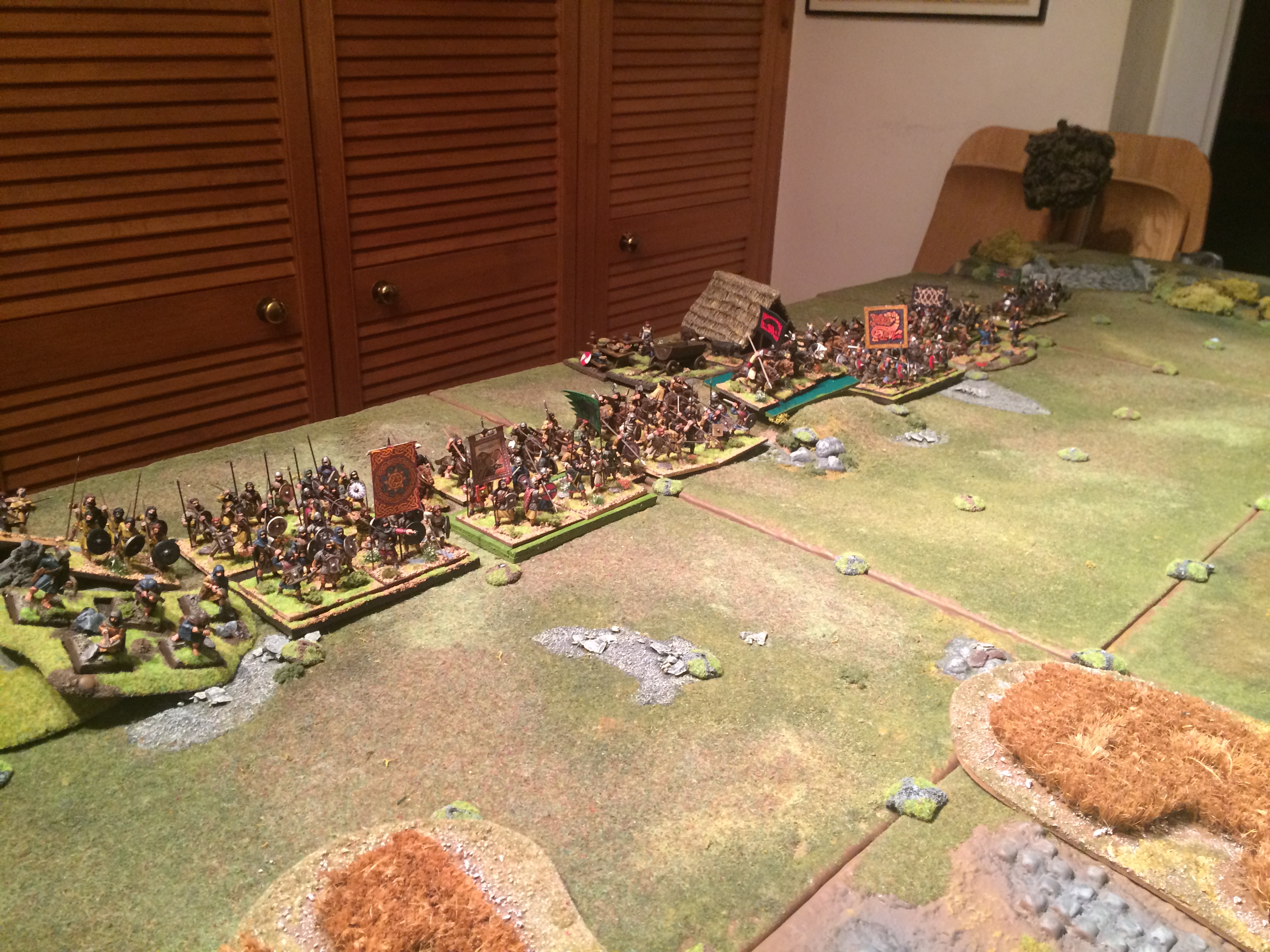
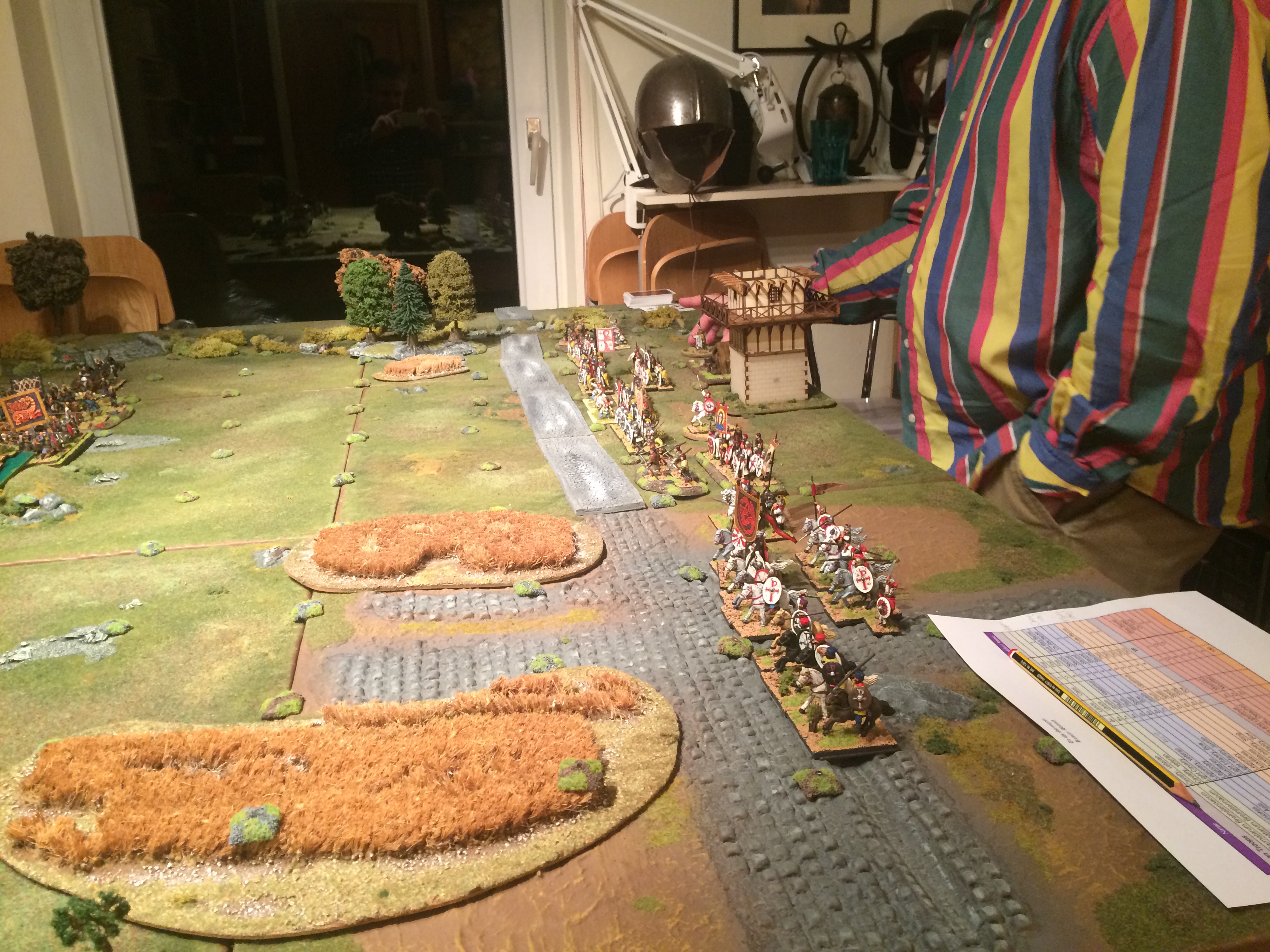
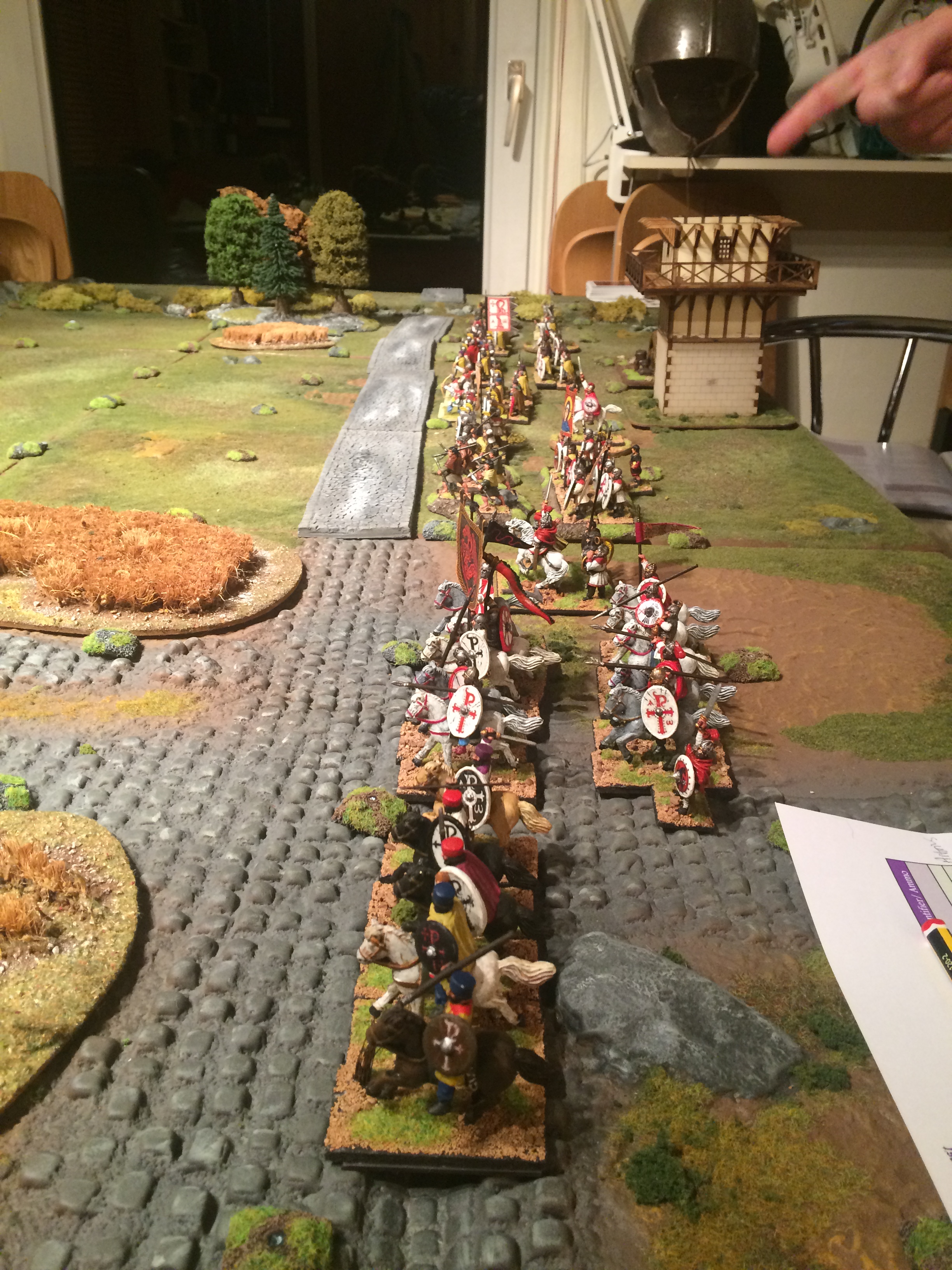
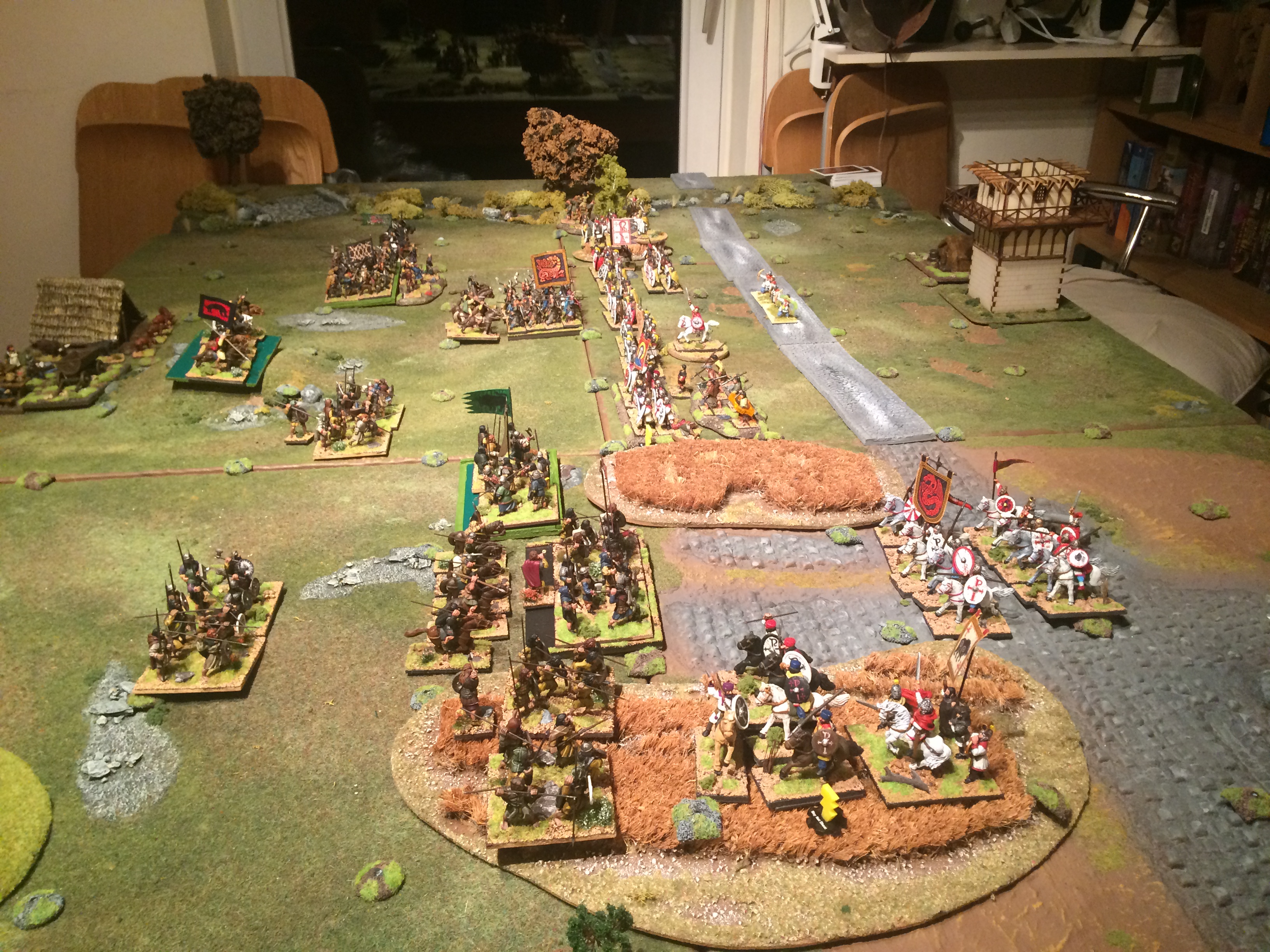
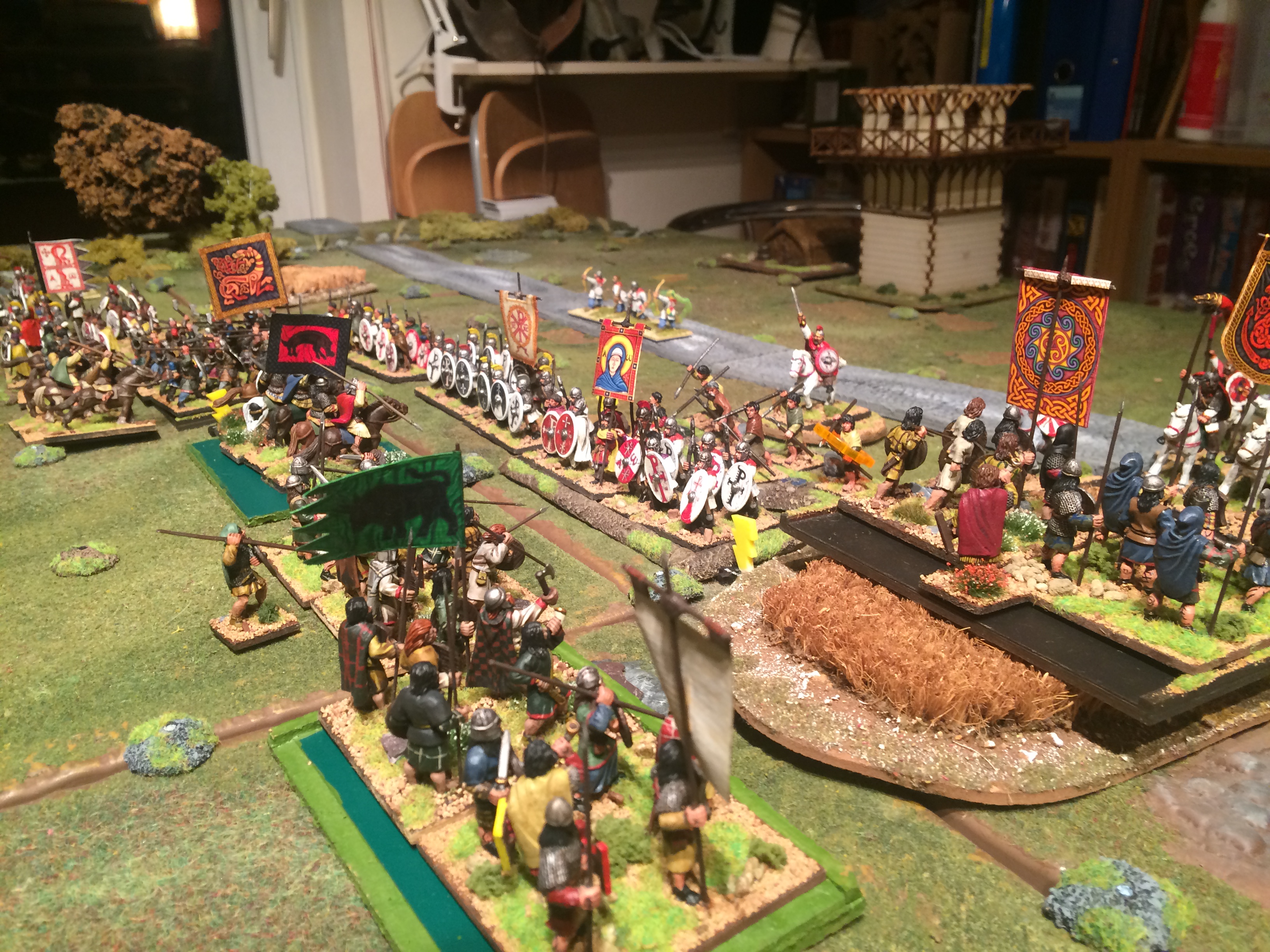
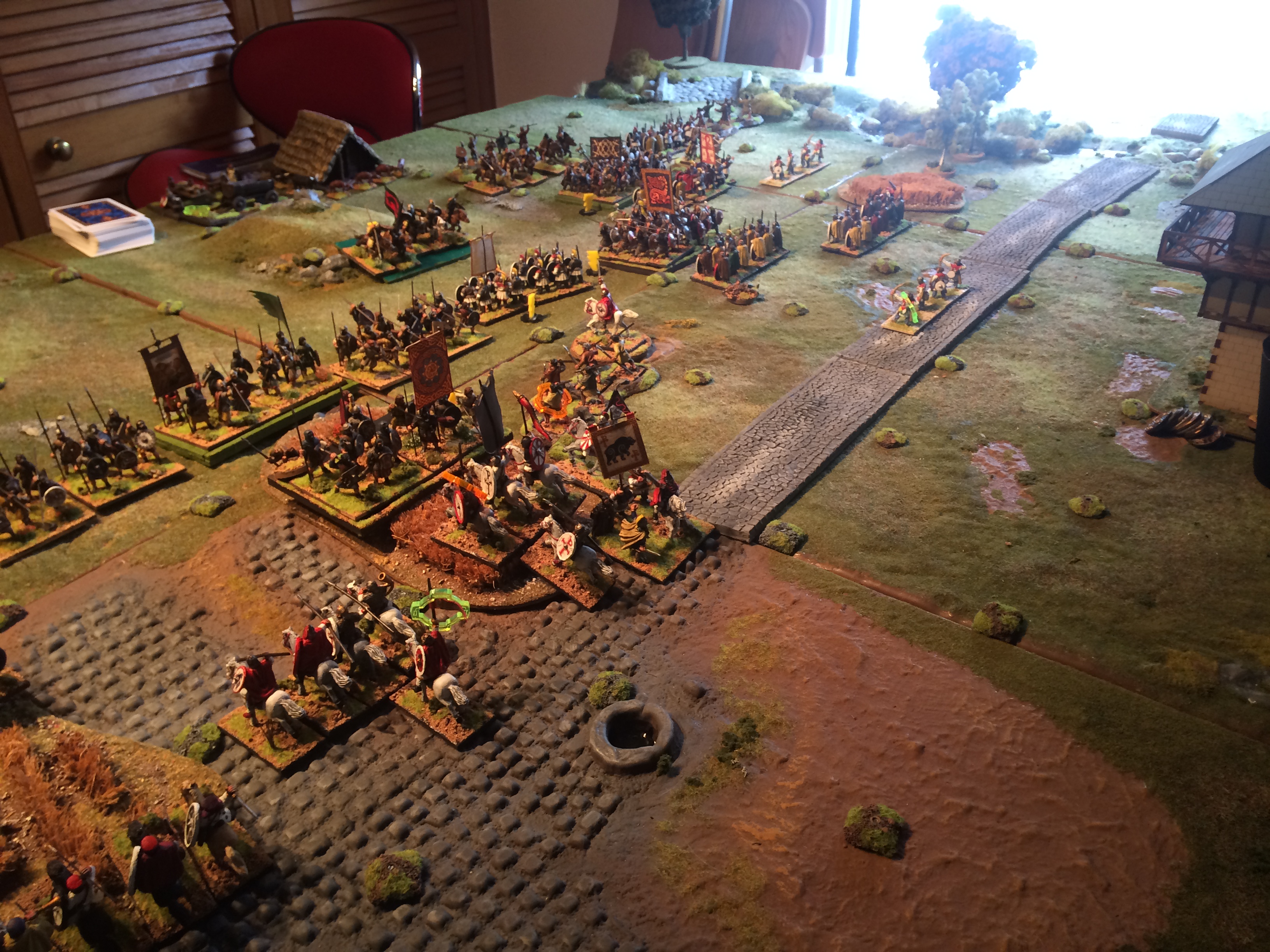
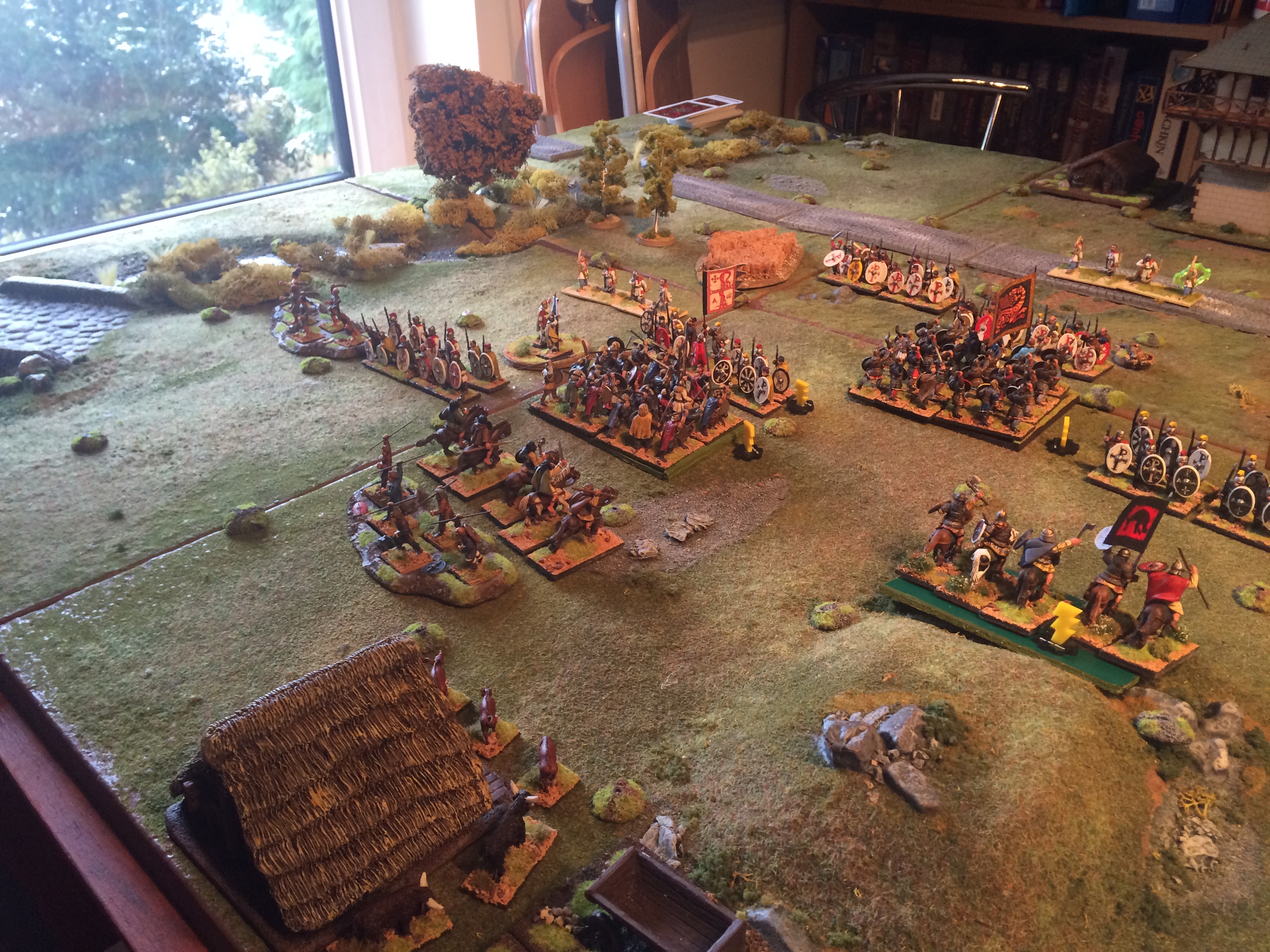
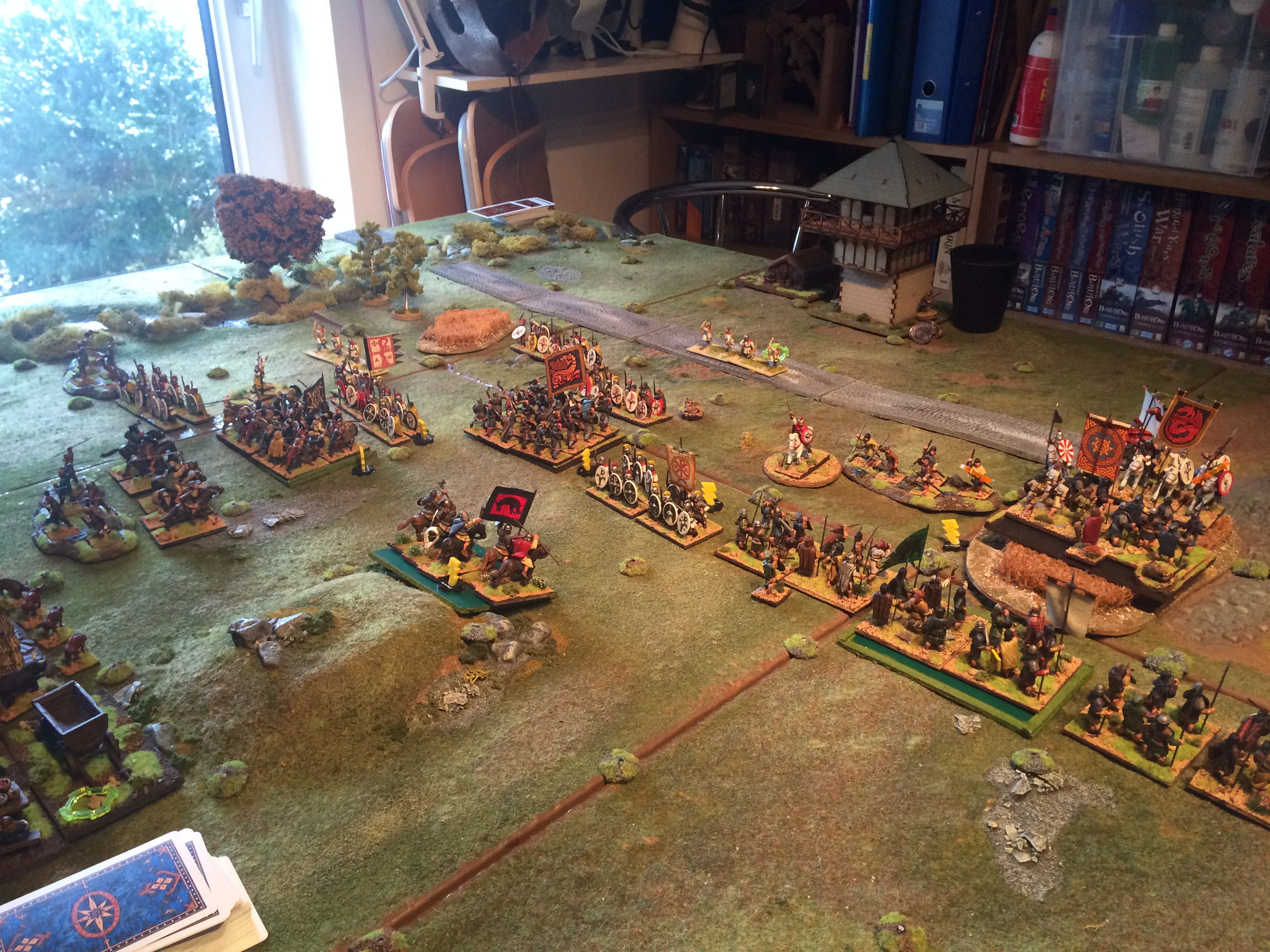
The forces set out for battle. Picts and Angles to the East and British to the West. The road runs from North to South with the Watch tower to the North.

The Romano-British.

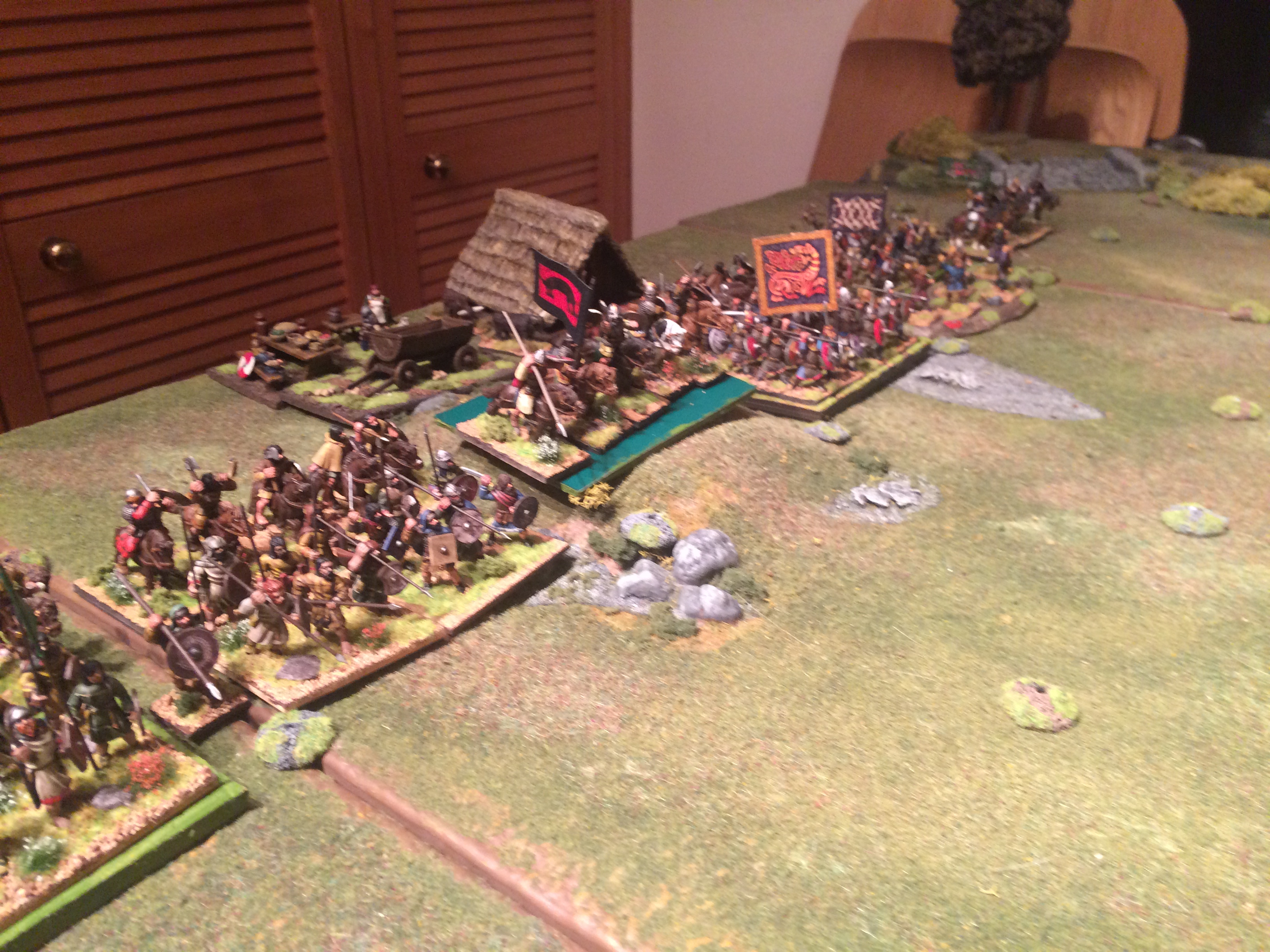
The Picts with the Angles on the Southern flank and the Pictish King and his cavalry held in reserve, light cavalry to the flanks.

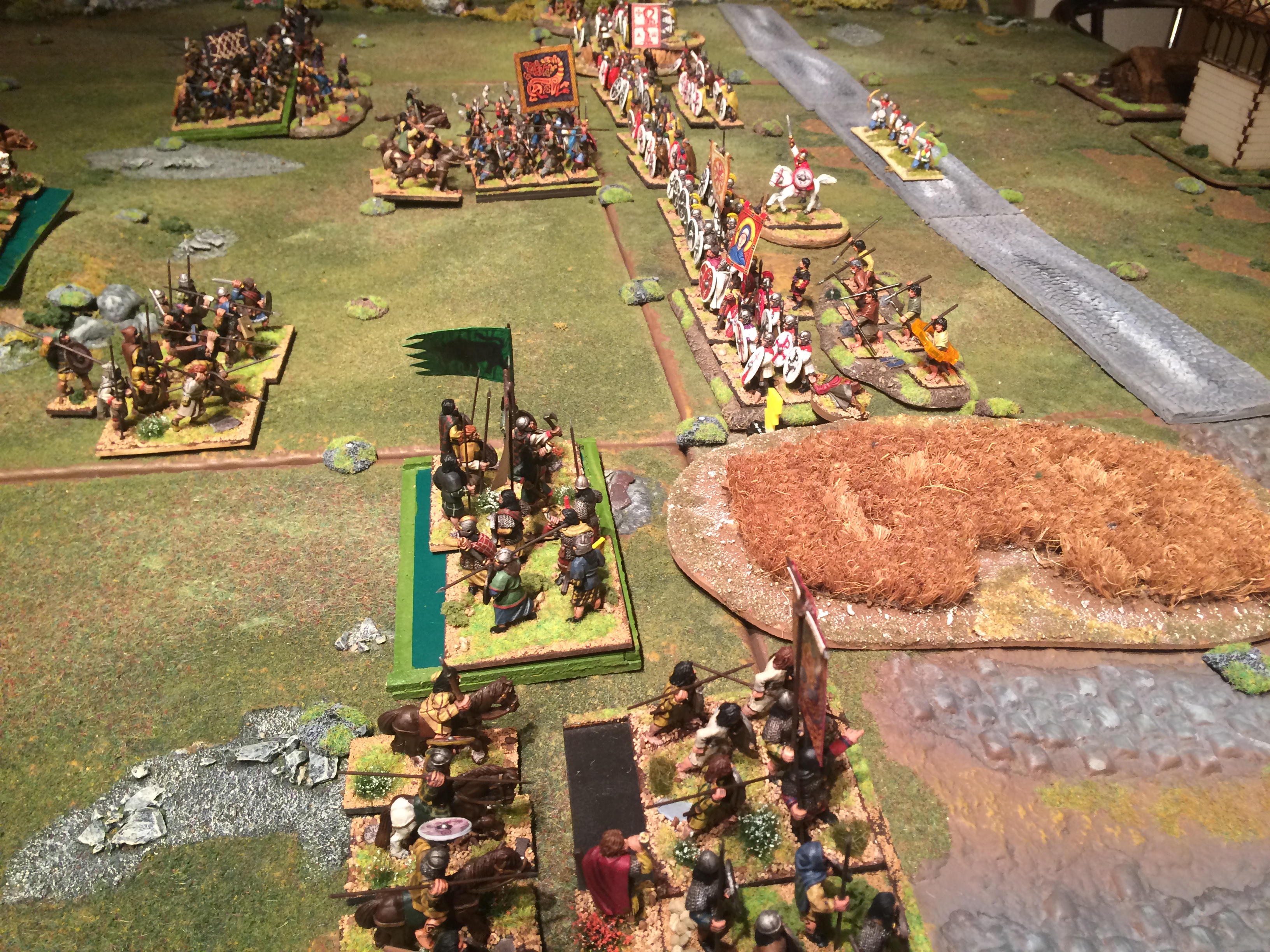
The Roman line advances steadily. A unit of light archers gets carried away with its enthusiasm but fails to fire.

The Elite Romano-British veterans beneath the Banner of the Virgin Mary.

Artorius beneath the bear banner with his cavalry.

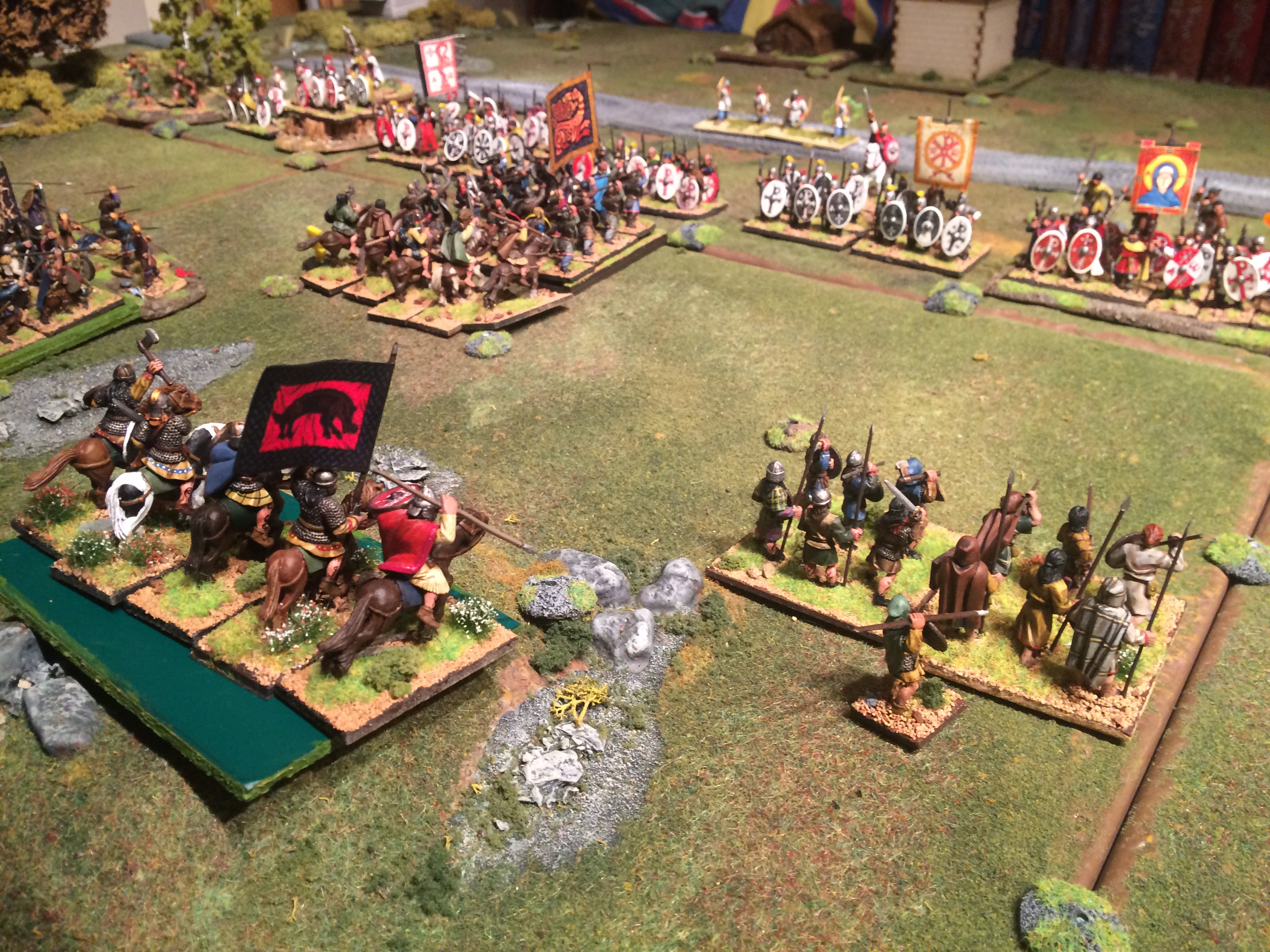
The Picts also advance rapidly. The unit of archers has succeeded in drawing out one unit ahead of the line of spears (being caught and Lost doing so).

The Pictish King rides to fill the gap and the Angle cavalry fail to move at all. A theme that gets oft repeated throughout the battle!

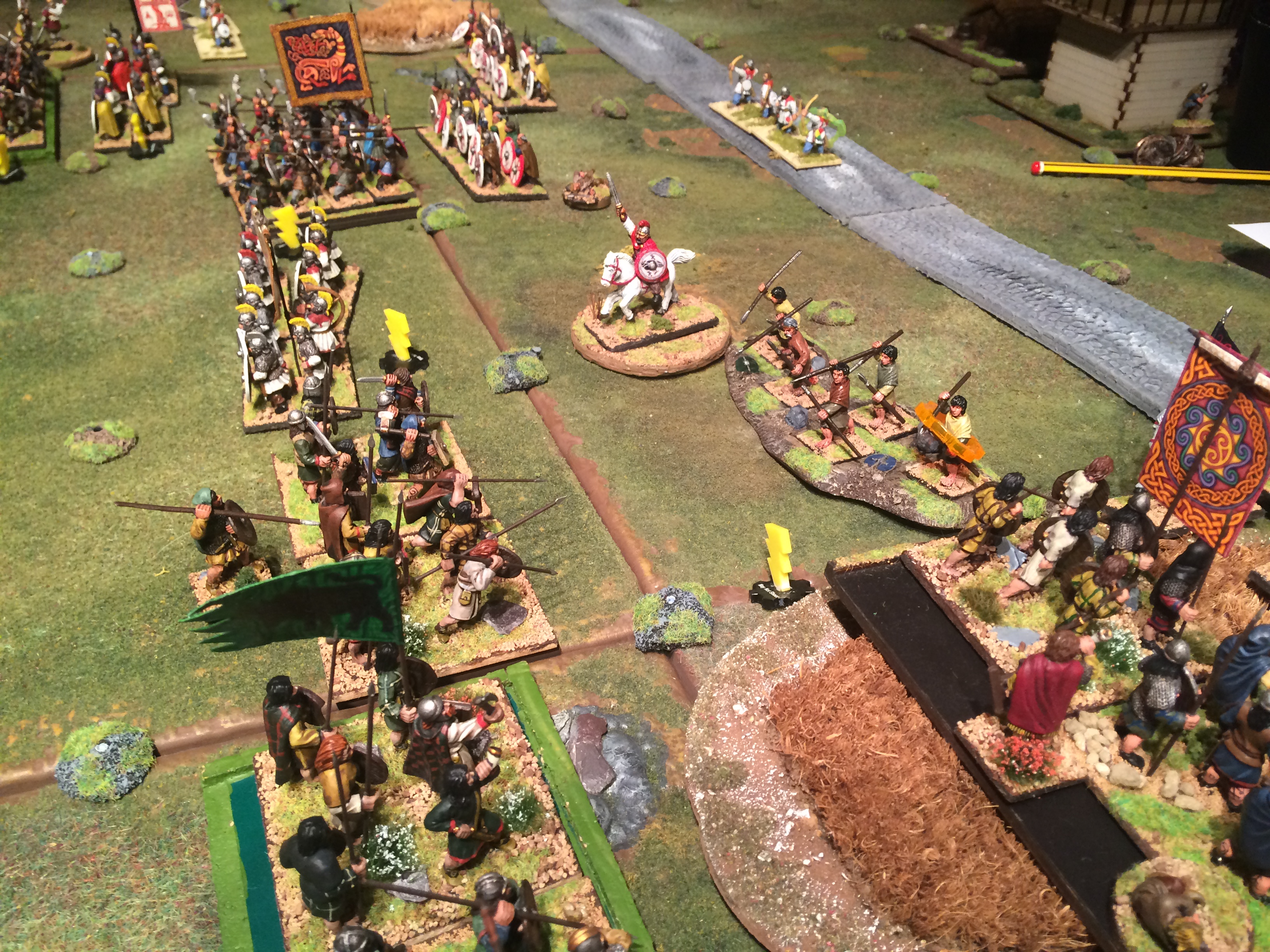
The lines close to the North as the British cavalry advance to the South.

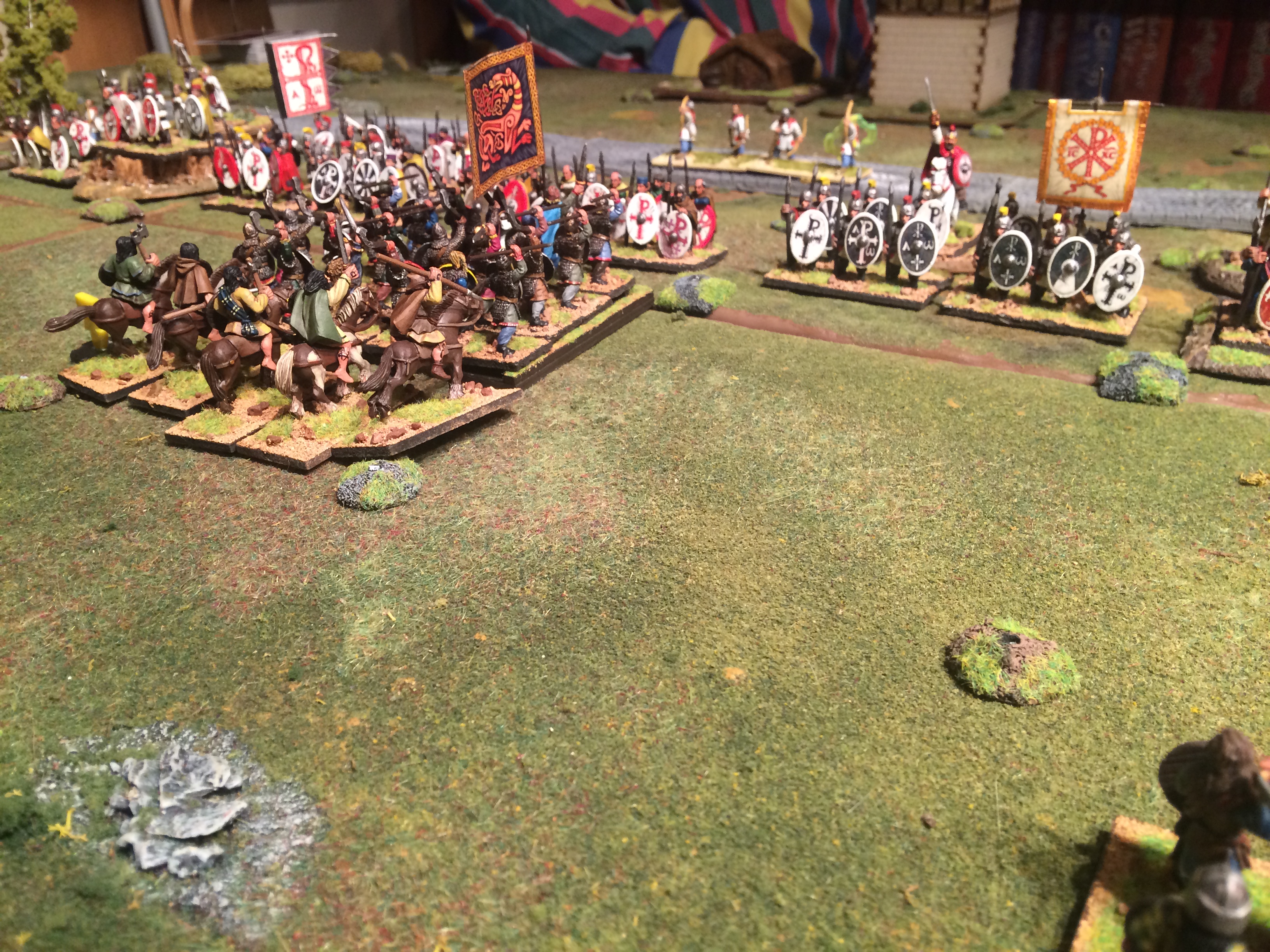
As the spearmen clash with the Romano-British infantry a gap opens in the British line.

The British Elite though stand firm beneath their Holy Banner.

The British cavalry drive away the Barbarian cavalry (who evade). The Angle cavalry remain motionless whilst all this goes on around them.
Subsequently the Romano-British clashed with the Angle and Pictish cavalry destroying the former and driving off the Picts who evaded. The Picts returned once on the Southern flank but then switched to the Northern flank once they were forced to evade again. As the Romano-British infantry and cavalry turned North and began to envelop them the Angles turned to stave off this advance but were eventually surrounded. To the North the British infantry advanced towards the camp but fearing encirclement by the Pictish Light cavalry retreated again until a gap appeared which they exploited to turn the flanks on the Pictish spearmen. With both flanks now threatened and with the losses mounting up the Pictish King retired from the field one last time: no doubt leaving the Angles to their fate with little thought other than it will give him more time to make good his escape.
I really enjoyed this learning game of To the Strongest. The card driven system works well especially for solo games. I had ordered Blue and Red Dragon decks which I really needed as I kept mixing them up after each turn!
The Barbarians had attached leaders whilst the Romano-British were detached and this gave the latter a greater ability to be present when required as one would expect. This actually makes a difference as the fighting starts up in earnest and towards the end it was Arthur’s presence alone which kept the infantry in place against the Angle Warriors. I had not initially realised that warriors were deep in case those eagle eyed amongst the reader’s notice and again fixing this towards the end made an interesting difference. The Angles with 3 hits stood a long time but were quite hard to move. Of course the Angle’s constant ability to fail to activate even with their leader is present (Two Aces seems to come up a lot) did not help. Their cavalry only moved at the end when the Picts had run away just in time to get hit in the flank by the Roman-British light cavalry who had travelled through the far North of the board and across the bridges to get there. The combat played quickly and though I did need to look up a few rules like evade, interpenetration and diagonal moves a few times I think it will be fairly straight forward to play once familiar. Both Arthur and the Pictish King took wounds in the fighting (being Heroic) but will live to fight again another day.
Certainly this campaign is not over as Artorius will now need to drive the main force of the Picts away from Eboracum and back across Hadrian’s and then the Antonine wall before the year is over and order is restored to the North.
StrongestRomanBarbarian2 Click to read the Army Lists.
A Song of Ice and Fire
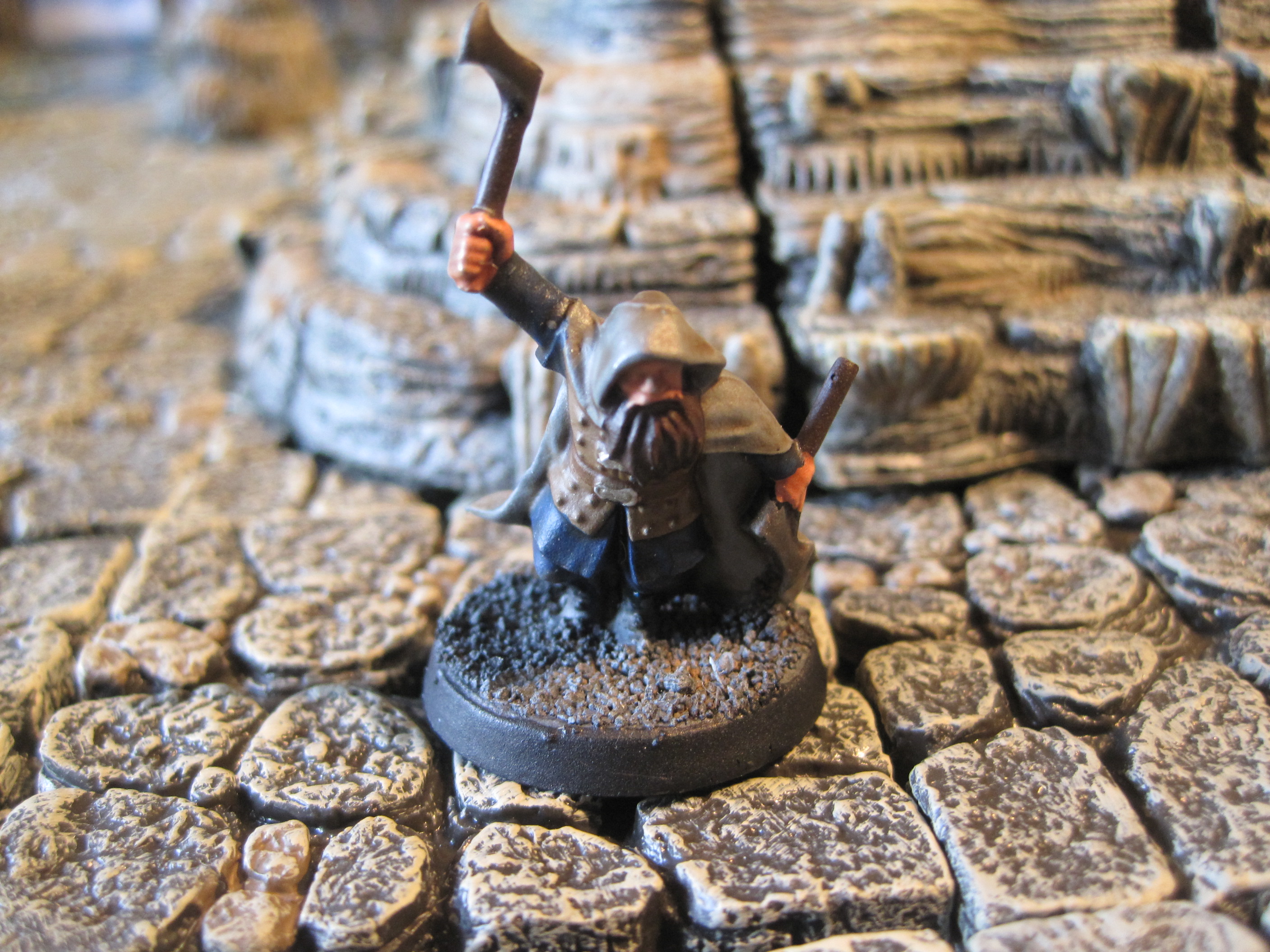
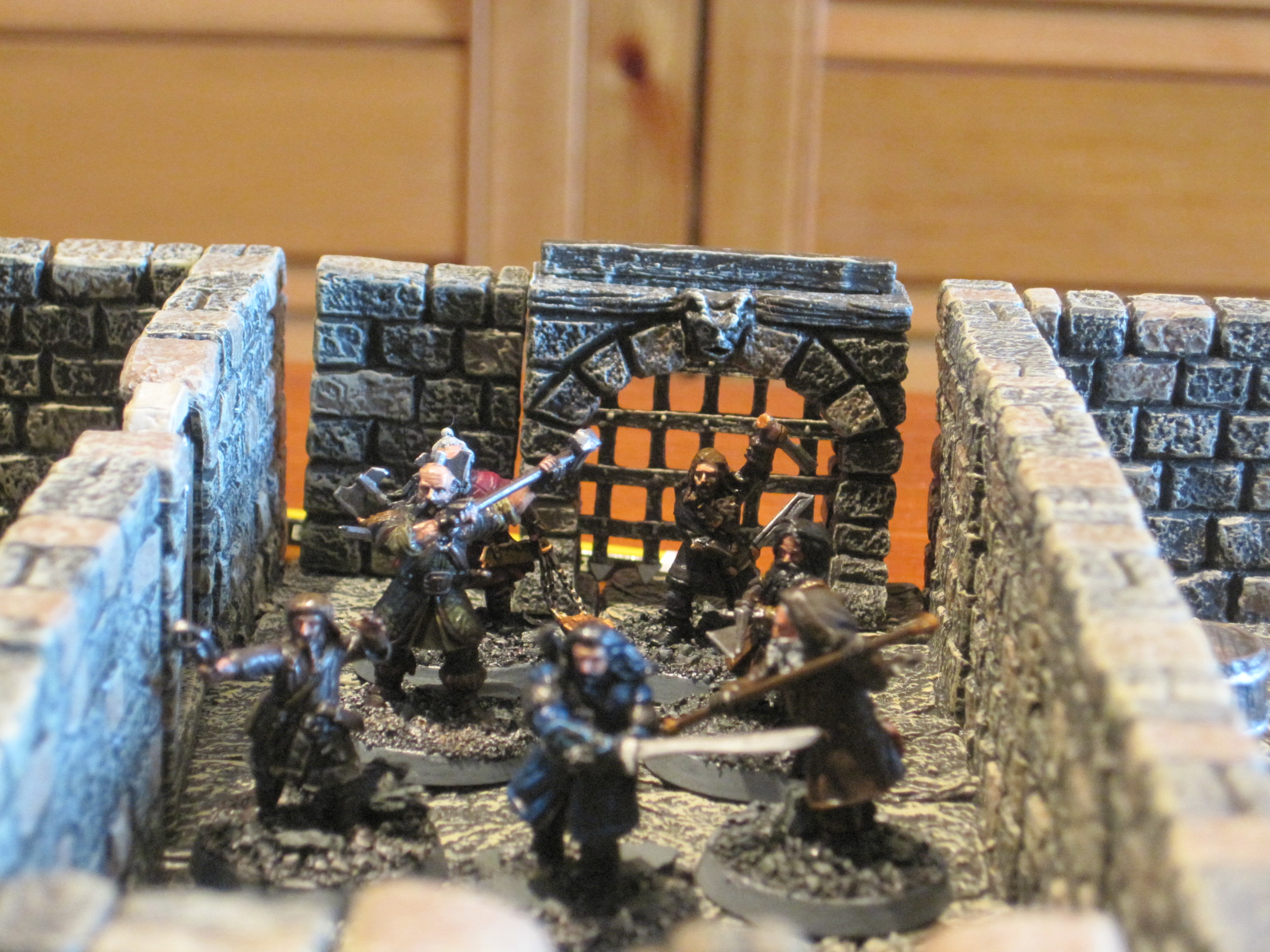
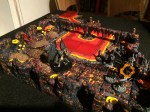
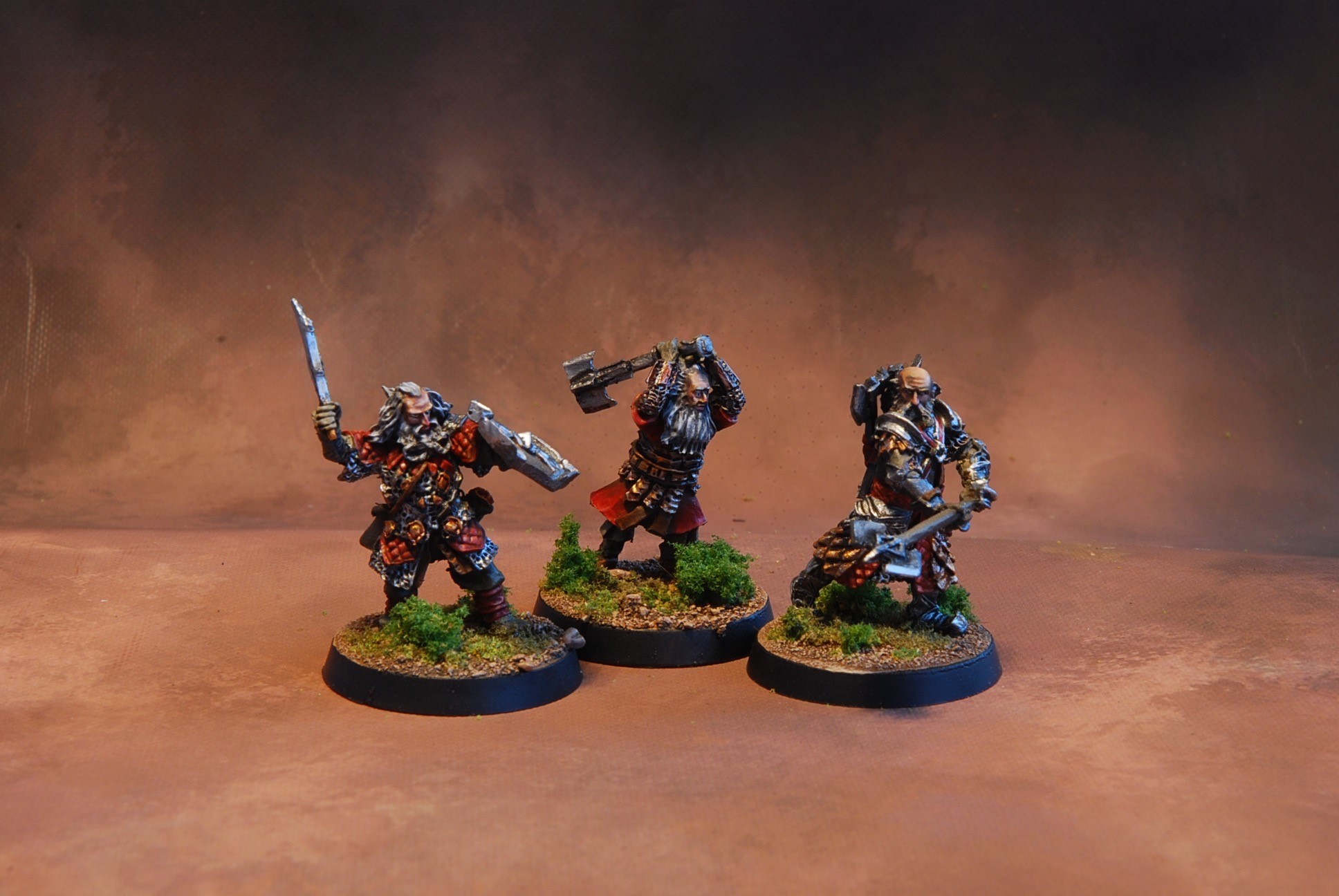
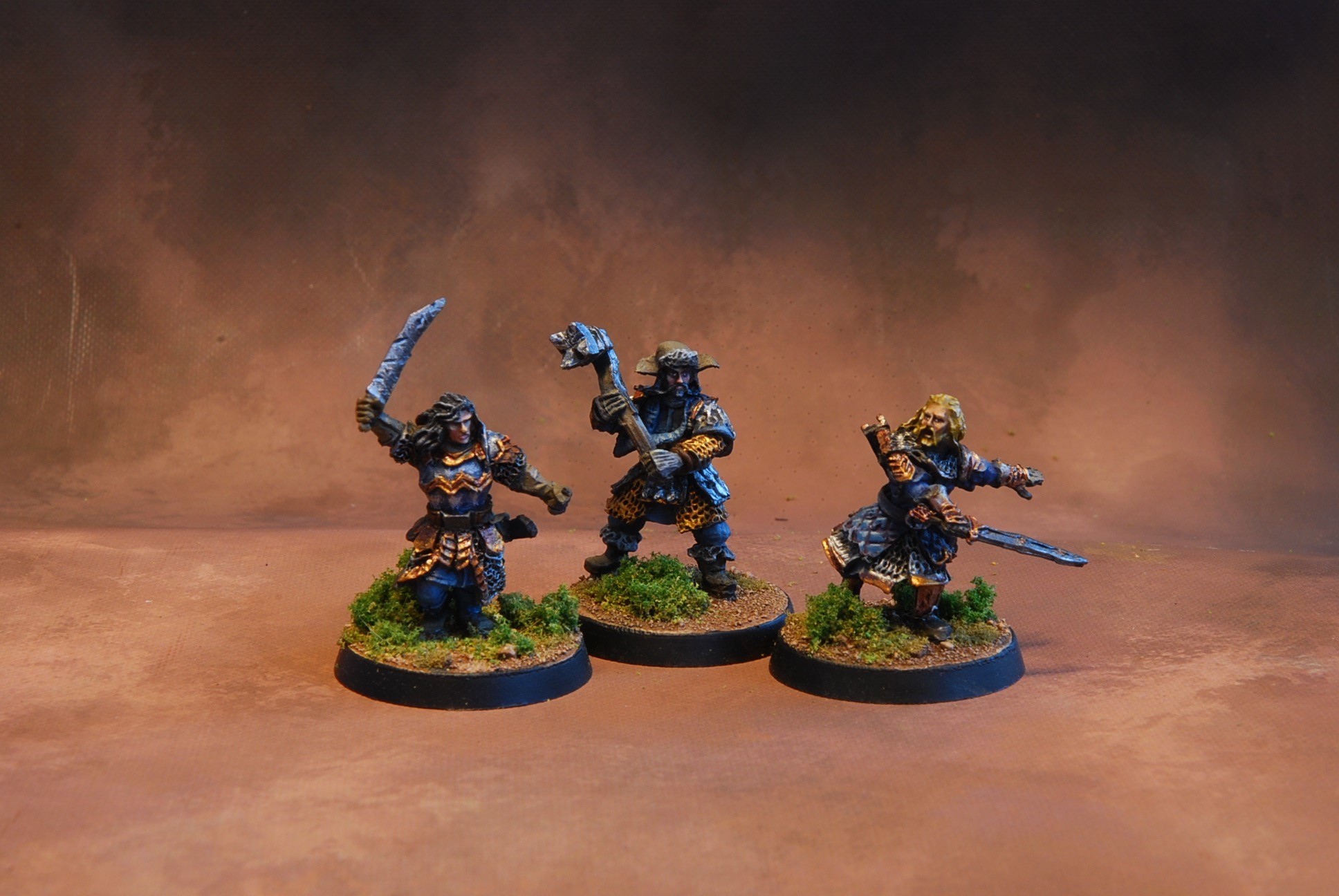
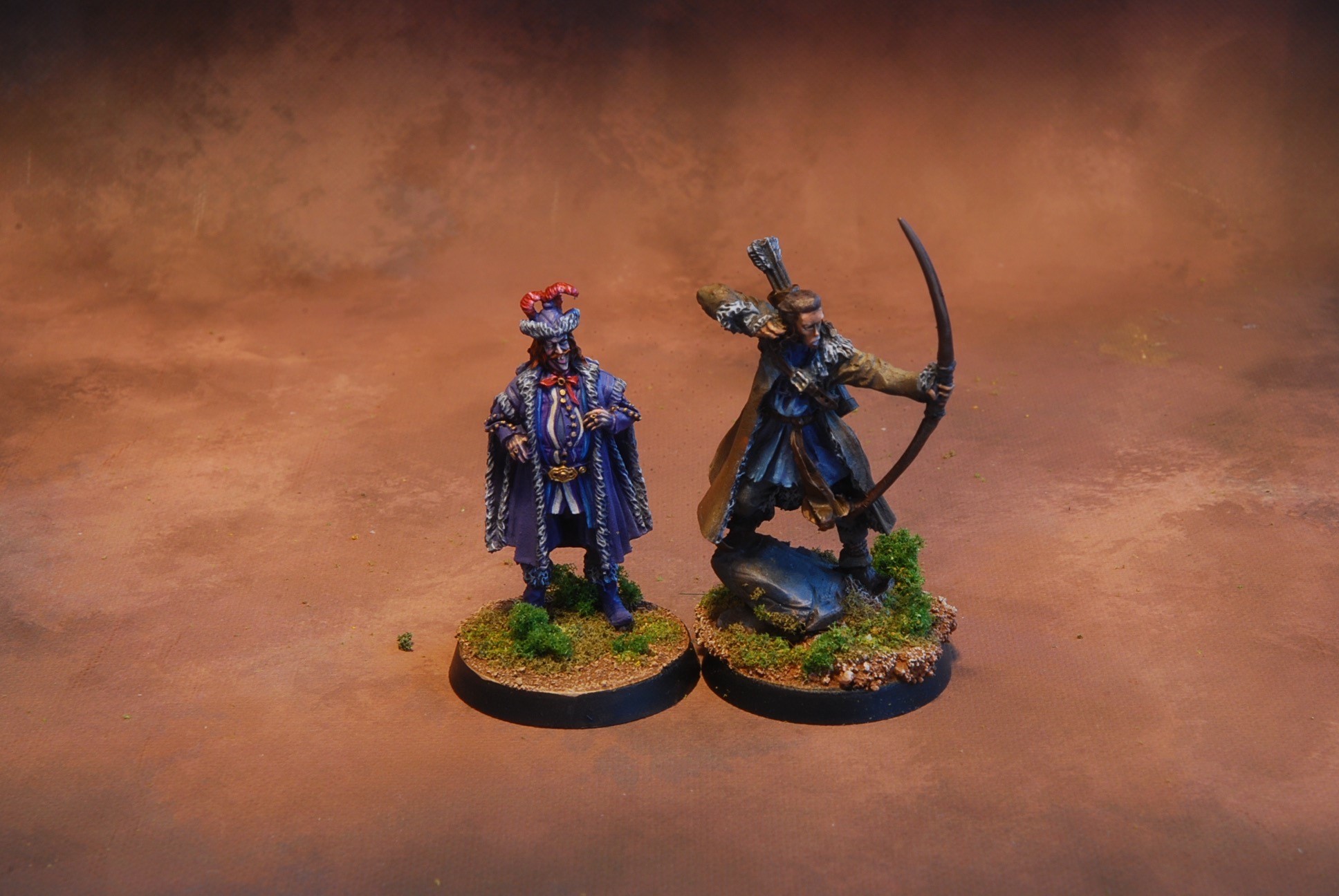
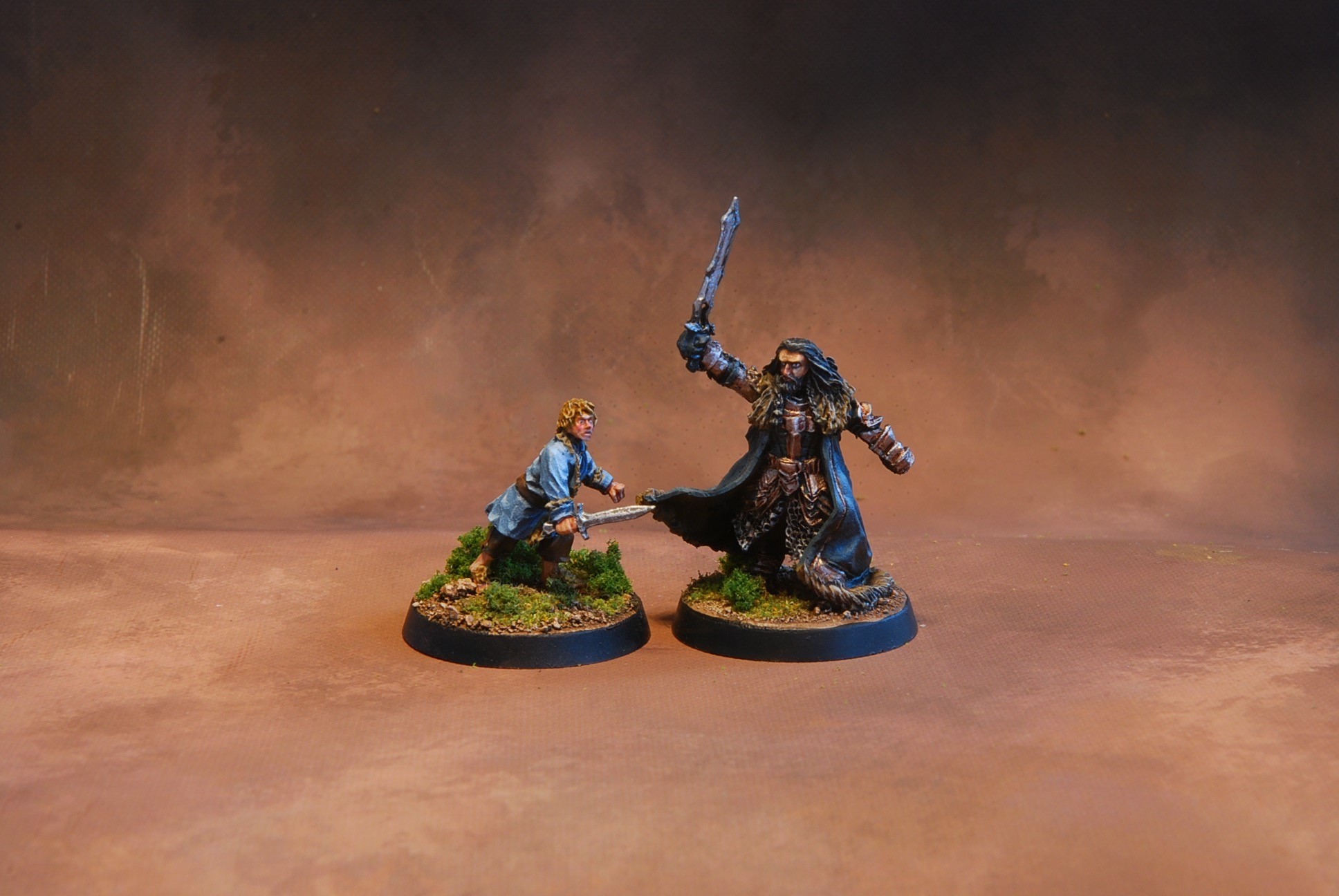
Thorin’s Company of Trusty Dwarves must brave the Dungeon. They have a map detailing a route through the mountain though it is unclear at points. The map is of a natural volcanic cavern that offers them a beneficial short cut on their quest. By all accounts the caverns lie abandoned but Gandalf suspects this may no longer be the case. Thorin however is determined to proceed.
Thorin and Co.
| Player: |
|
| Points: |
Personality: 189 (38%) |
Warrior: 314 (62%) |
Total: 503 |
| Victory Points: |
|
| Notes: |
|
|
| Warband Advances: |
|
|
| Dwarf Leader; Thorin – Personality |
| Points 95 |
Quality 2+ |
Combat 4 |
| Special Rules |
Fearless, Leader |
|
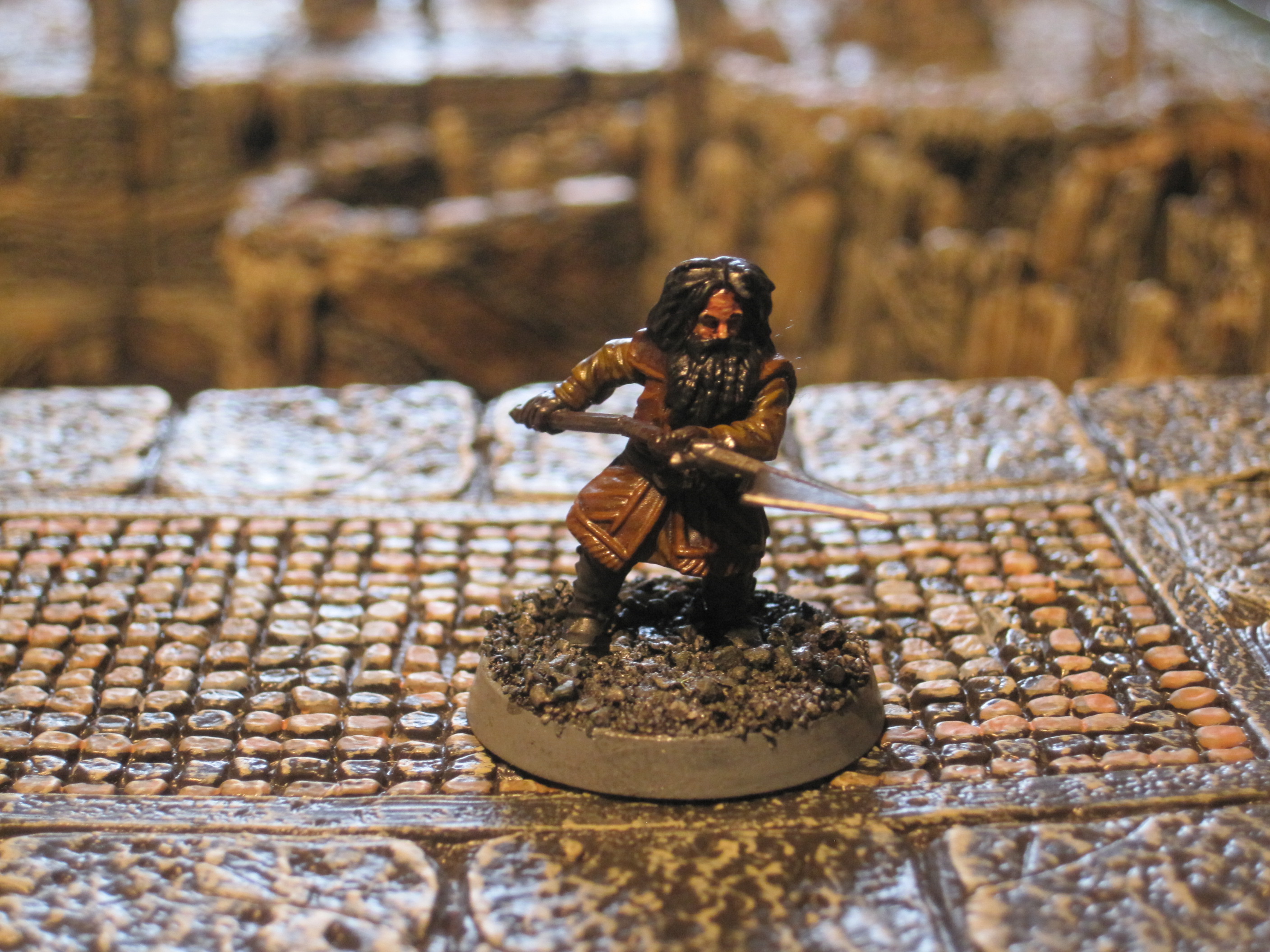
| Dwarf Goblinslayer: Dwalin |
| Points 40 |
Quality 3+ |
Combat 4 |
| Special Rules |
Lethal, Short Move |
|
| Halfing Thief: Bilbo |
| Points 22 |
Quality 3+ |
Combat 1 |
| Special Rules |
Free Disengage, Short Move, Stealth, Traps |
|
| Dwarf Skirmisher: Ori; Slinger |
| Points 18 |
Quality 3+ |
Combat 2 |
| Special Rules |
Shooter: Short, Short Move |
|
| Dwarf Elite Archer: Fili |
| Points 40 |
Quality 3+ |
Combat 3 |
| Special Rules |
Sharpshooter, Shooter: Medium, Short Move |
|
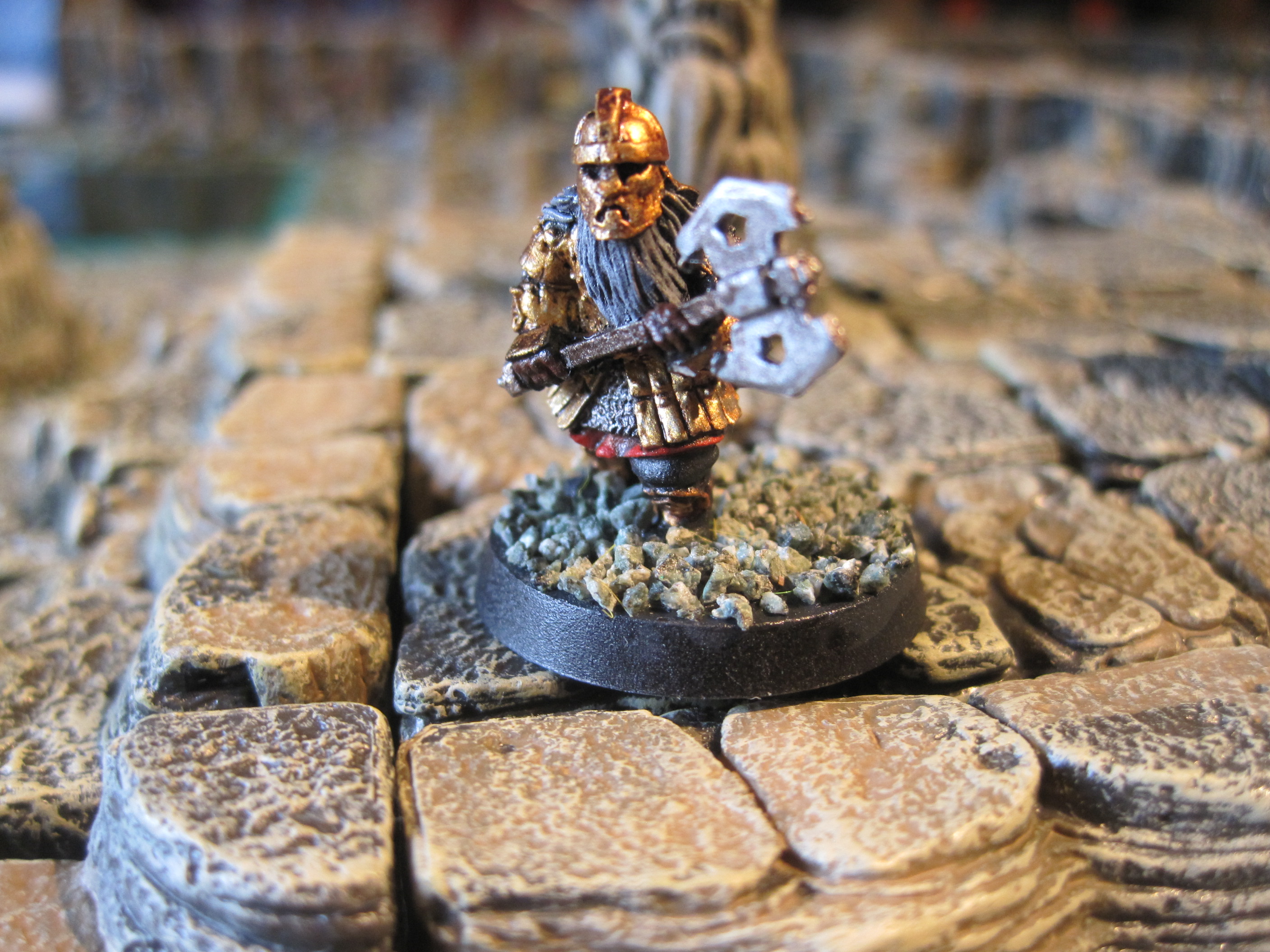
| Dwarf Elite Warrior: Bofur, Balin |
| Points 46 |
Quality 3+ |
Combat 4 |
| Special Rules |
Fearless, Short Move, Steadfast |
|
| Dwarf Elite Warrior: Bofur, Balin |
| Points 46 |
Quality 3+ |
Combat 4 |
| Special Rules |
Fearless, Short Move, Steadfast |
|
| Dwarf Cleric: Oin – Personality |
| Points 54 |
Quality 3+ |
Combat 3 |
| Special Rules |
Cleric, Short Move |
|
| Wizard: Gandalf – Personality |
| Points 40 |
Quality 3+ |
Combat 1 |
| Special Rules |
Magic-User |
|
| Dwarf Warriors: Nori, Dori, Bifur |
| Points 34 |
Quality 3+ |
Combat 4 |
| Special Rules |
Short Move |
|
| Dwarf Warriors: Nori, Dori, Bifur |
| Points 34 |
Quality 3+ |
Combat 4 |
| Special Rules |
Short Move |
|
| Dwarf Warriors: Nori, Dori, Bifur |
| Points 34 |
Quality 3+ |
Combat 4 |
| Special Rules |
Short Move |
|
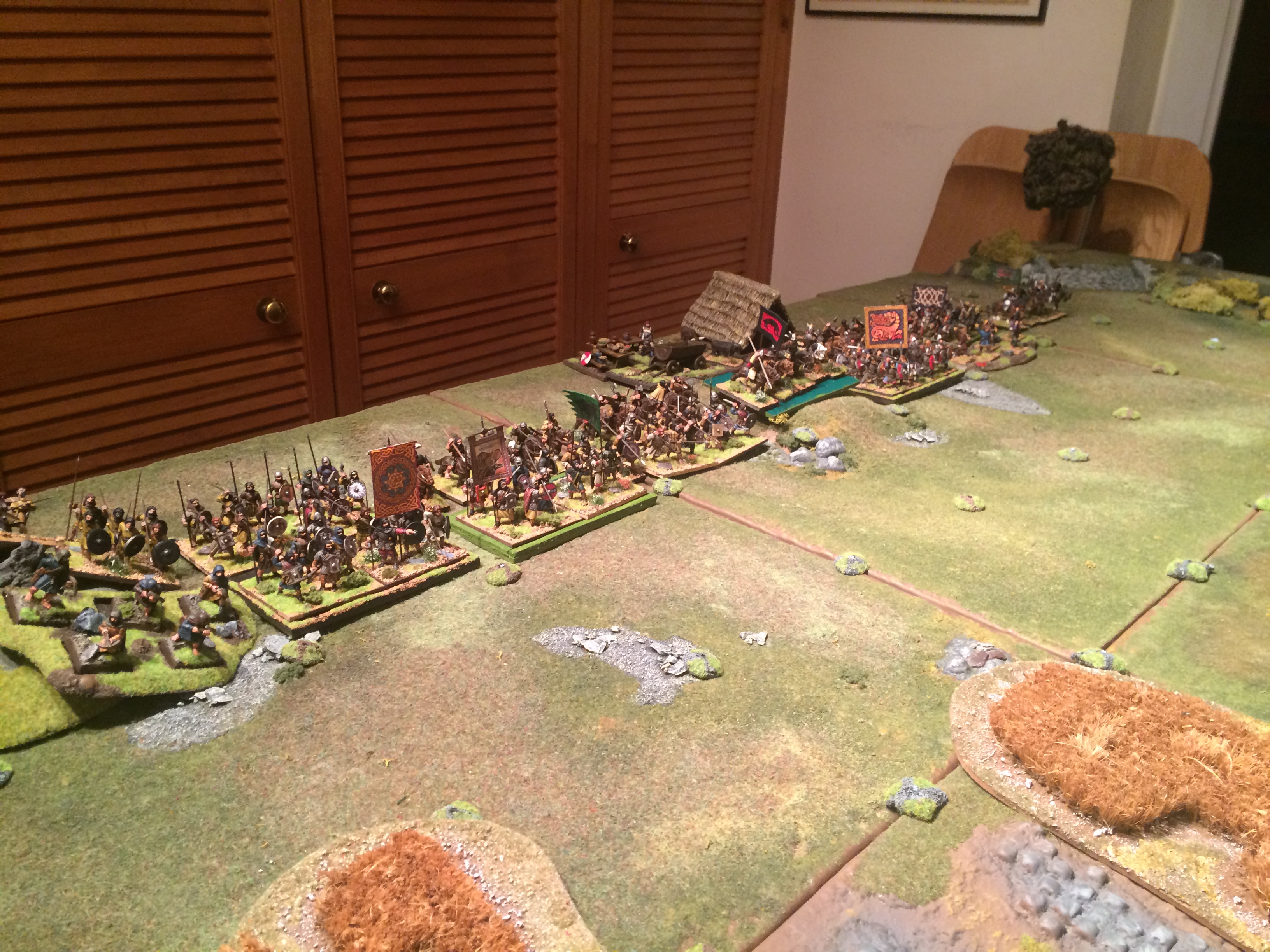
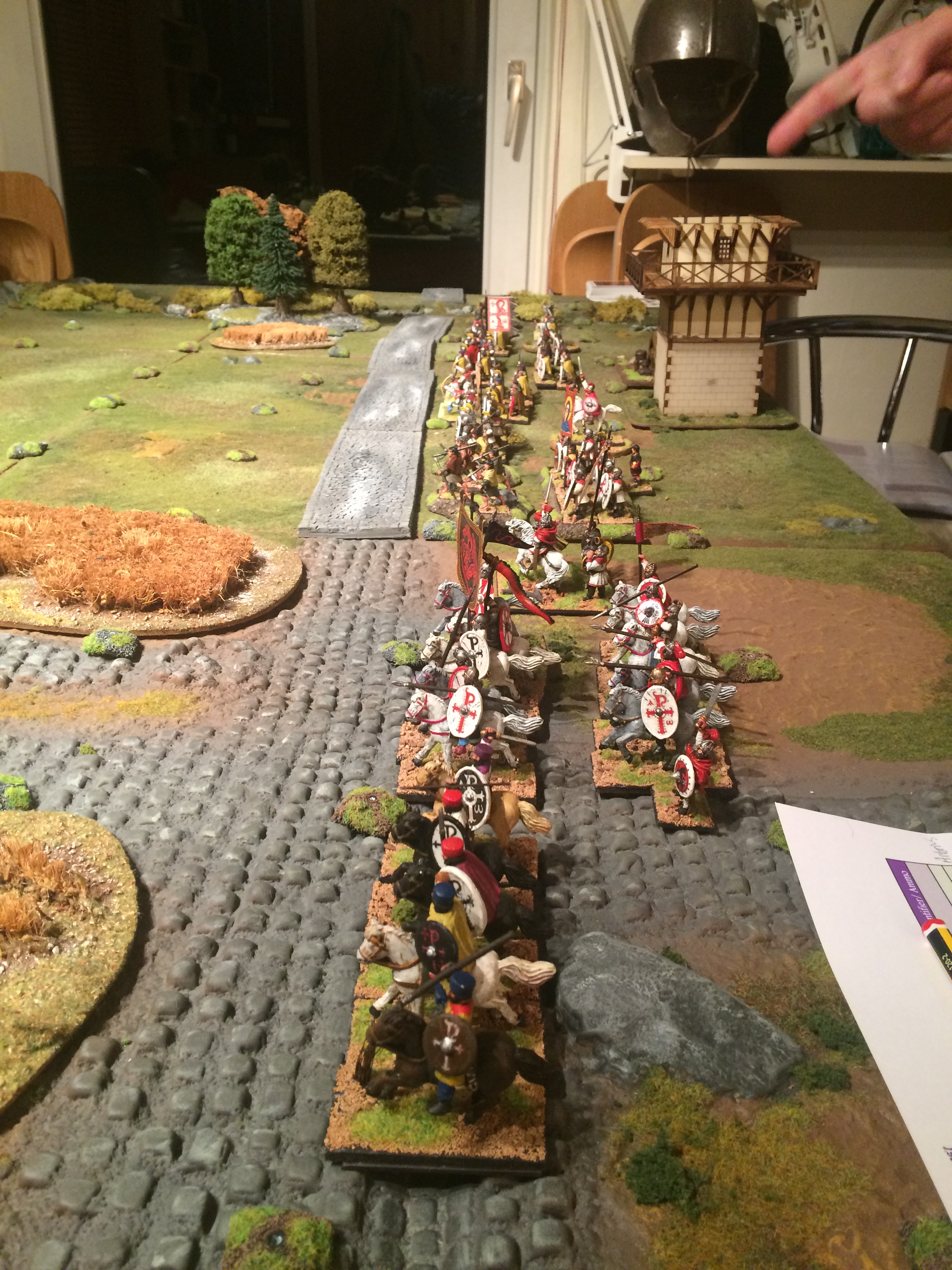
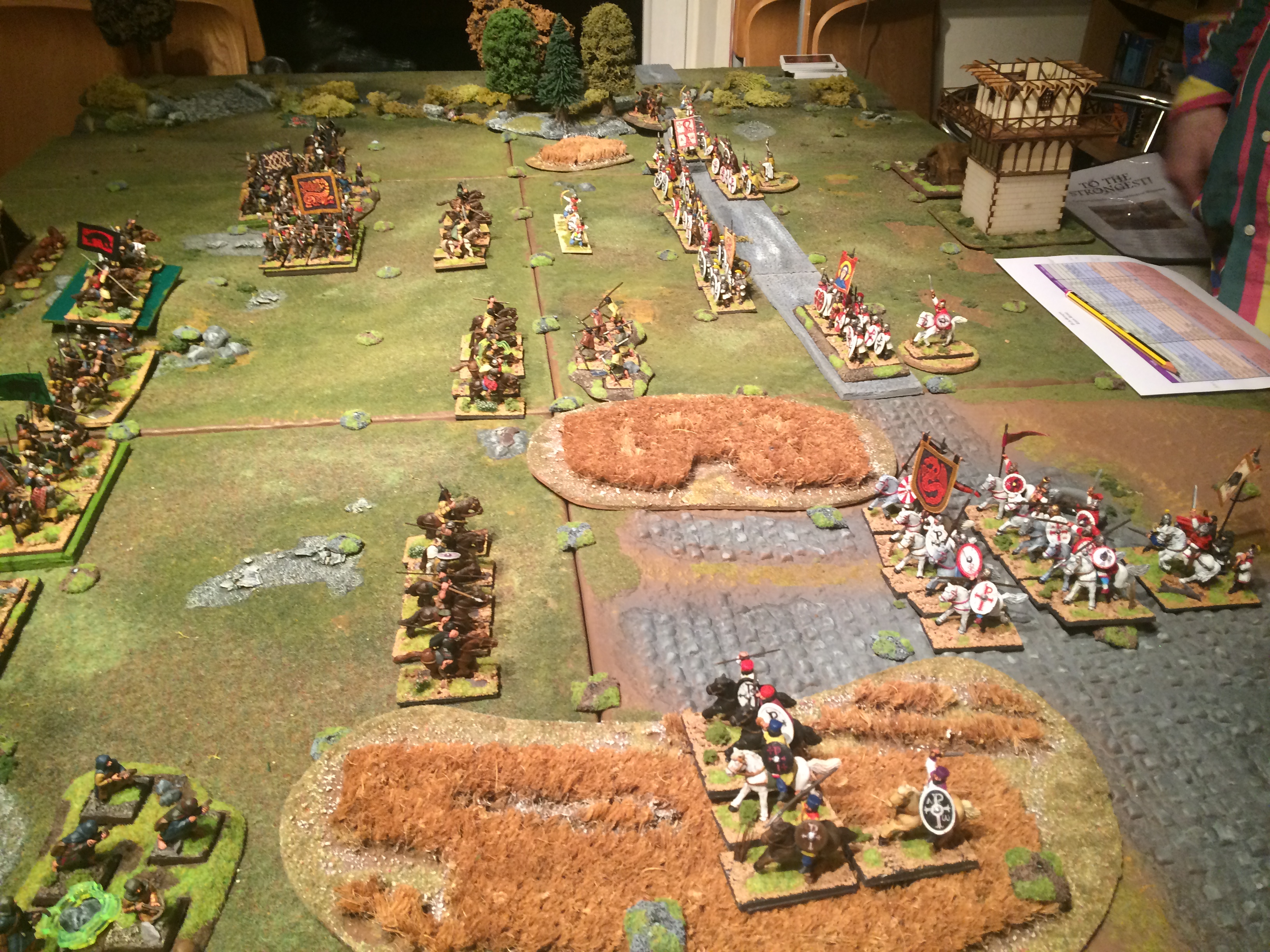
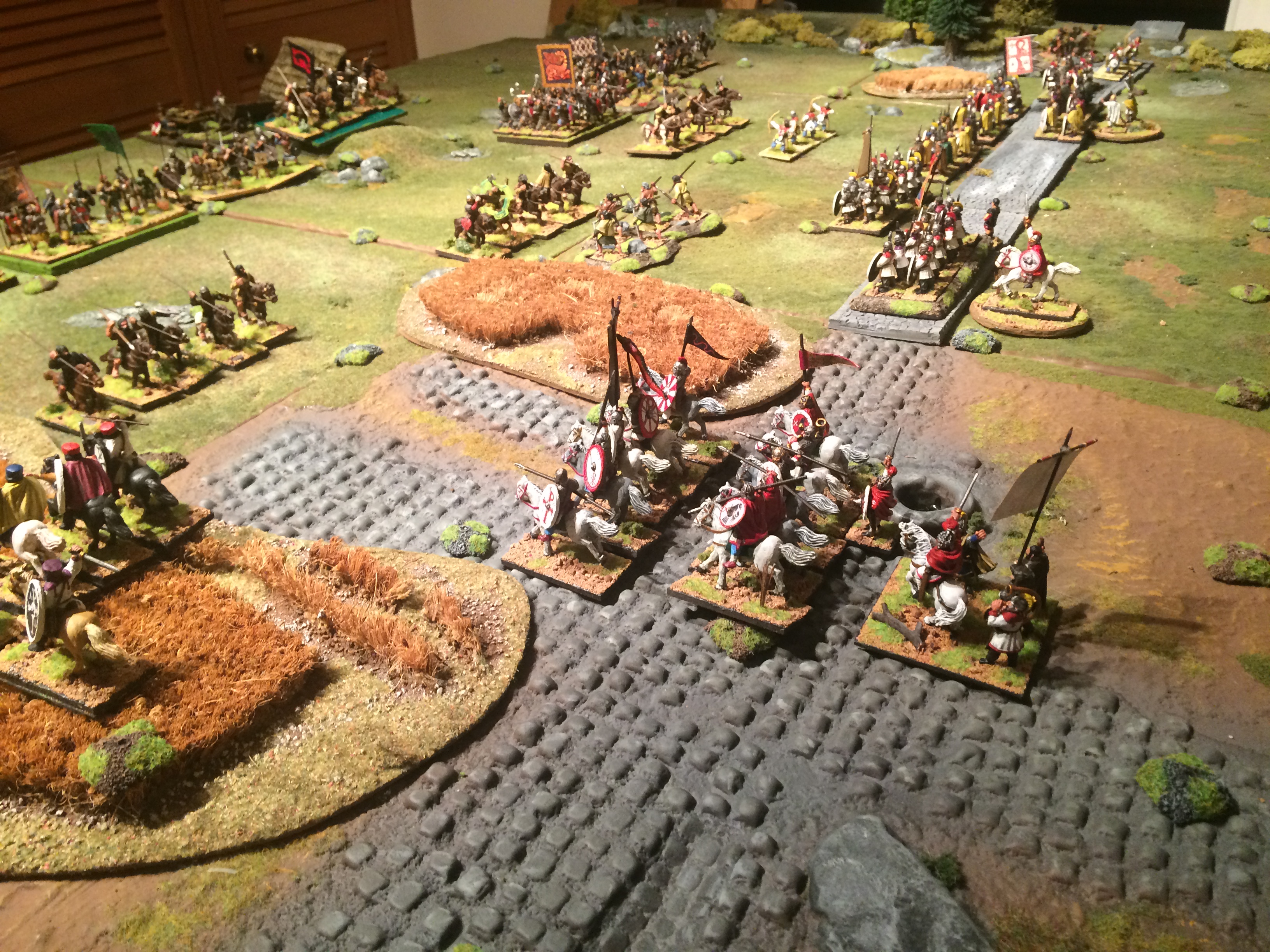
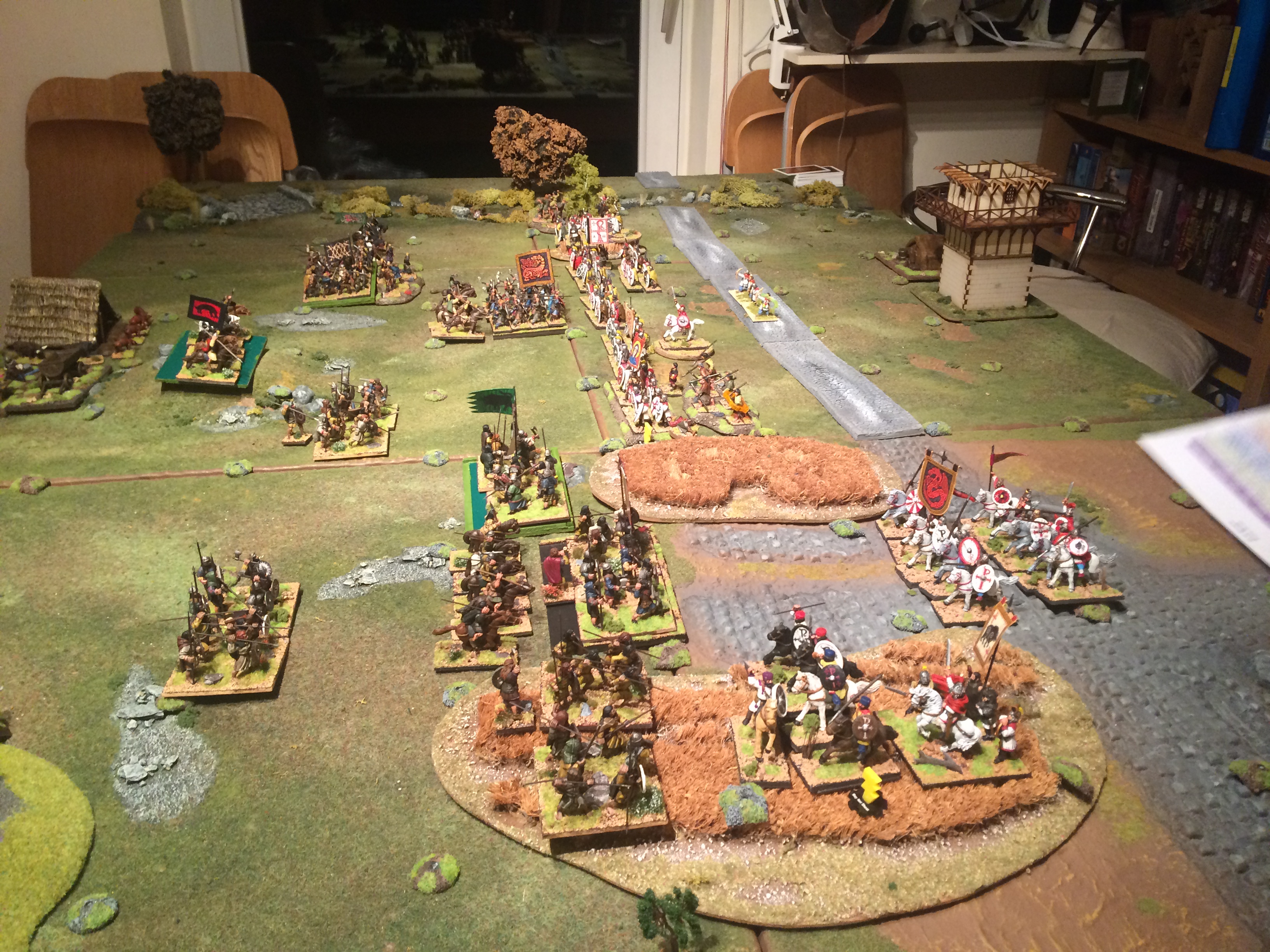
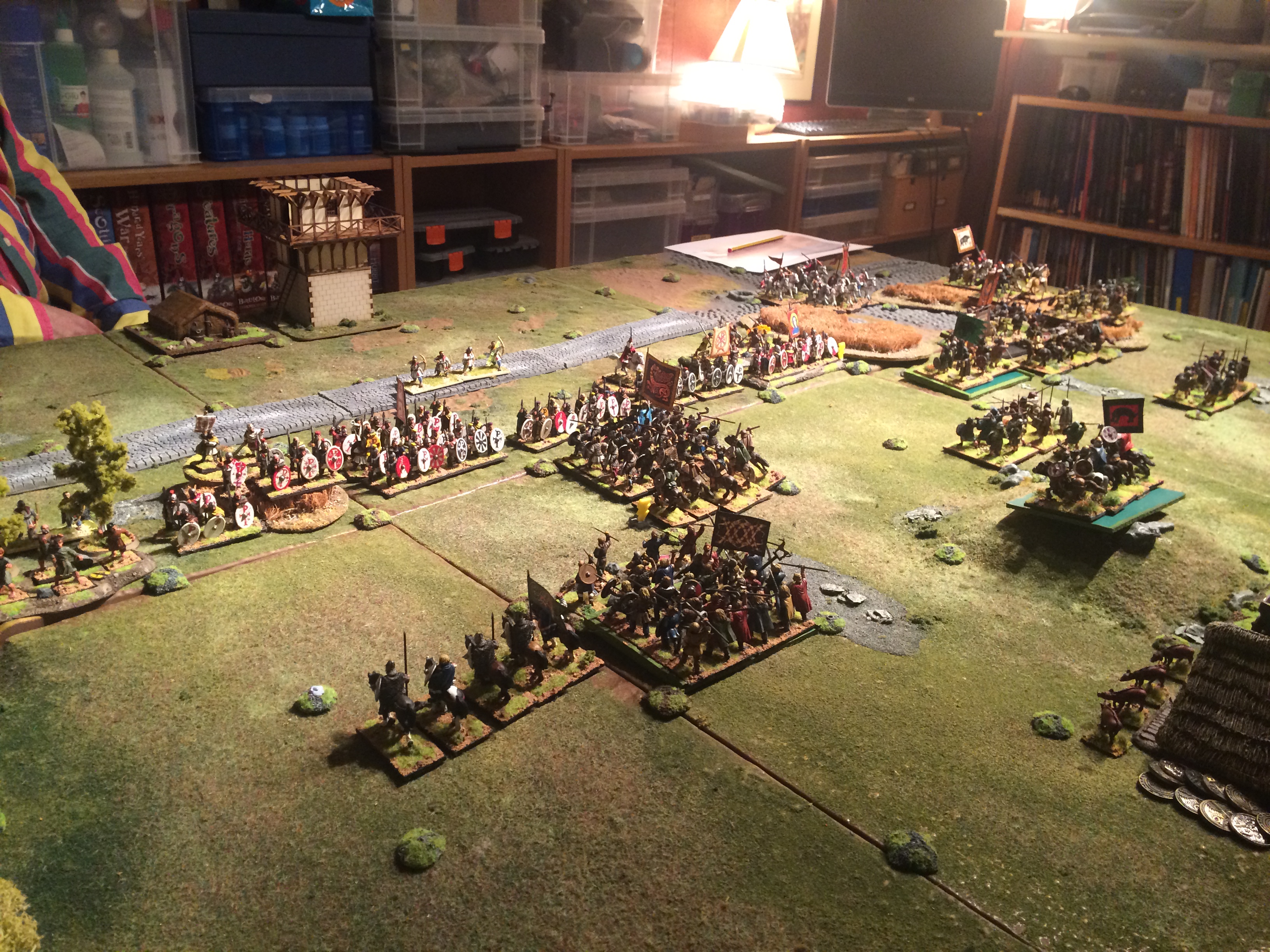
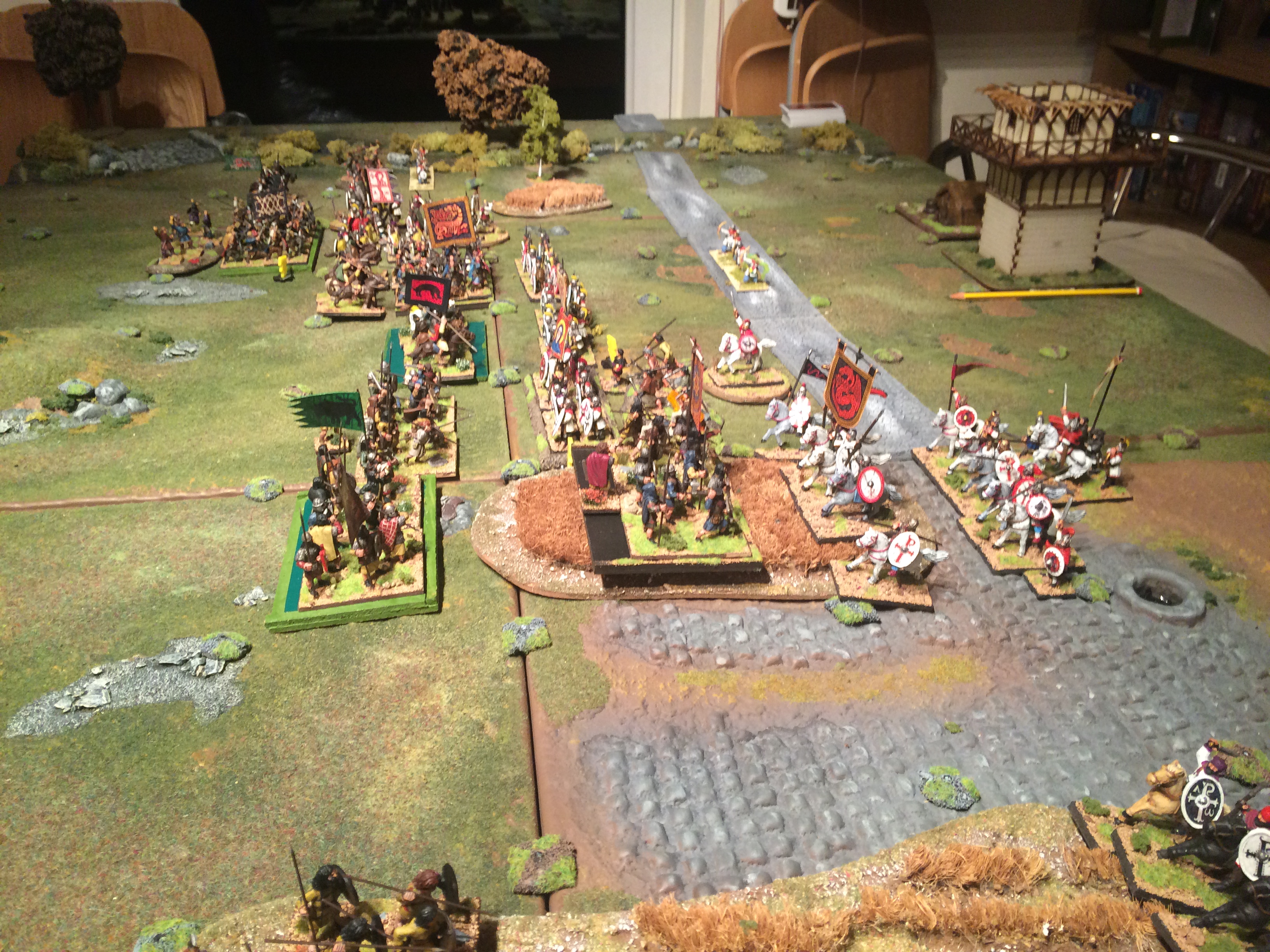
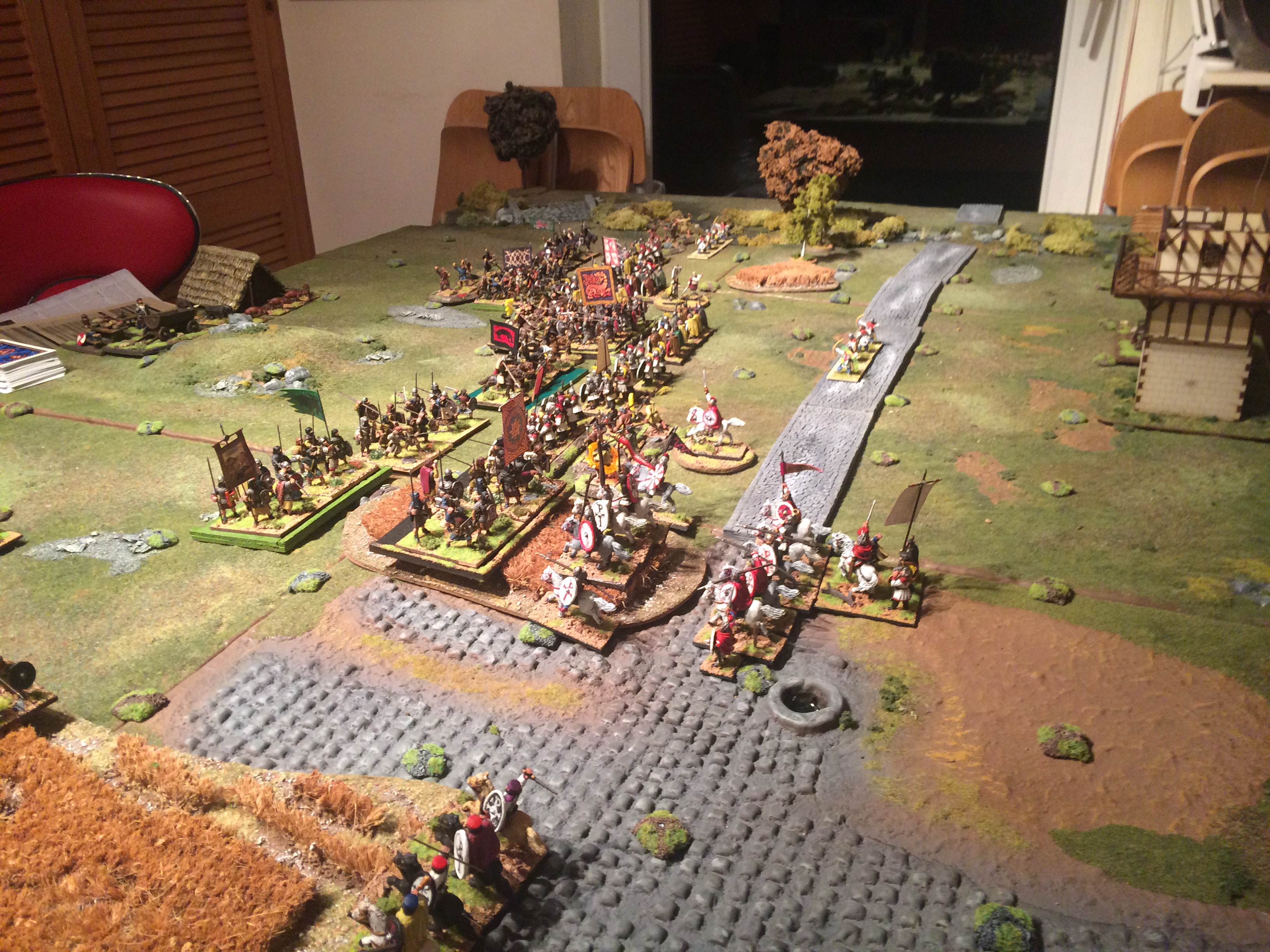
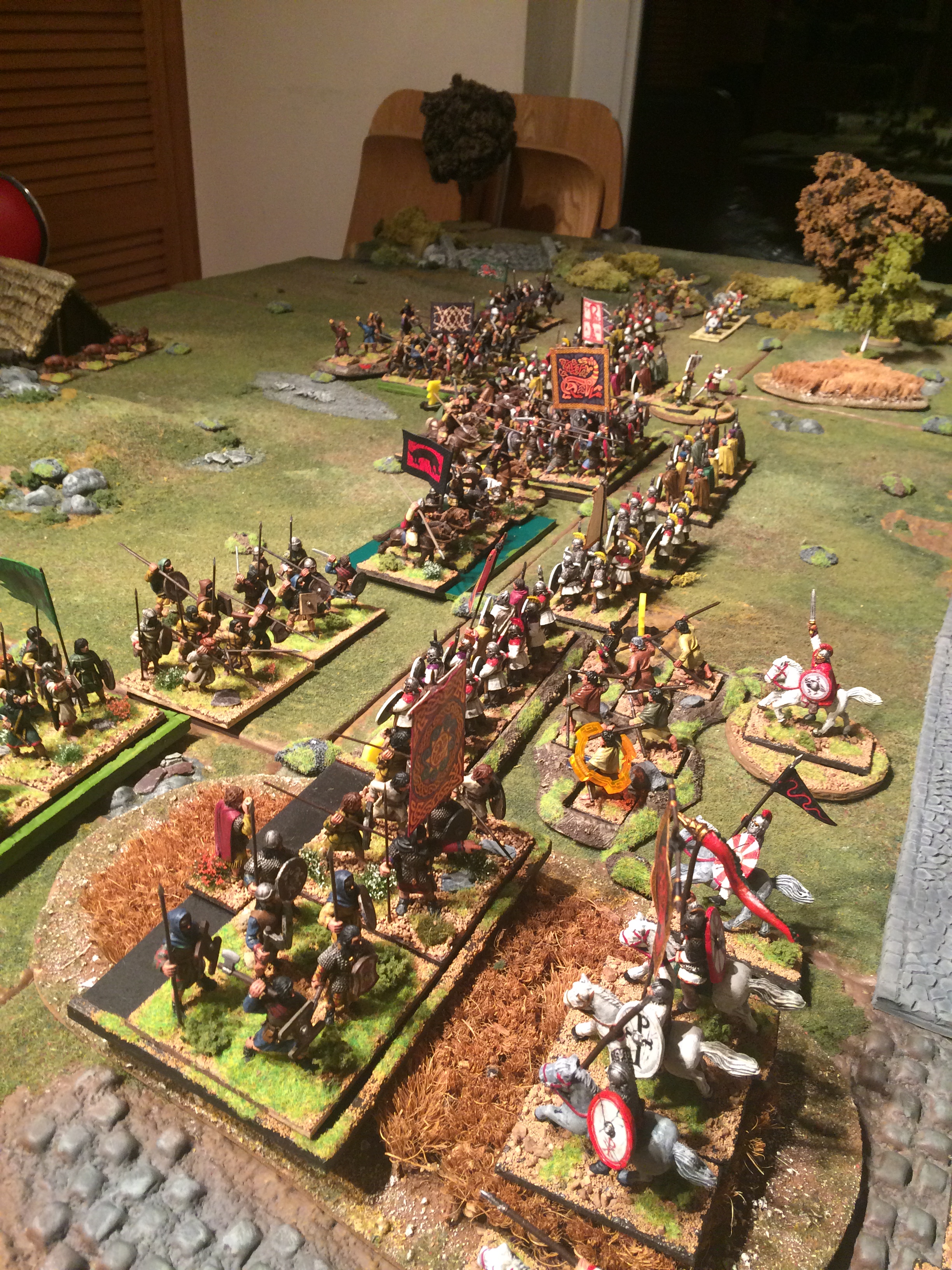
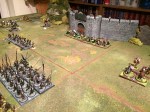
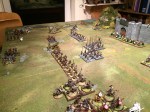
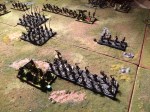
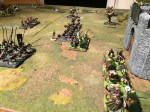
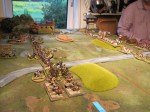
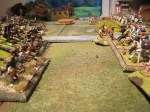
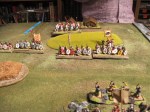
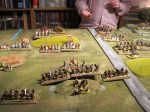
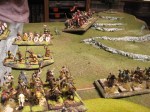
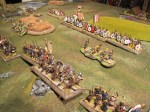
The Hunnic Empire and their Subject Gepid allies have crossed the Danube and are raiding and pillaging as they go into Roman territory. A relief force of Roman Field Army troops have mobilised in defence. Intercepting the invaders at a river crossing guarded by a watch tower along a Roman road the Romans prepare for battle. A Church burns already looted by advancing raiders whilst the forces deploy for battle. The Romans deploy first with Cataphracts and light horse to their left flank and infantry cantre and right. The Huns deploy cavalry on their own right flank with infantry centre and left. The Gepid shock cavalry deploy to the rear left flank awaiting a gap in the line to smash through.
Mike’s Romans certainly had the better of the action dice. However they rolled badly when saving against being hit in combat. In the end we decided it was a very close barbarian victory. The Hunnic cavalry advanced rapidly and even charged the Cataphracts deployed to shore up the gap on the Roman left. They charged whilst the Romans had no action die but lost one unit of horse archers who had strayed too close in the process. The Cataphracts however held their ground whilst more huns attempted to encircle them. In the centre both infantry lines eventually clashed with no real winners on either side. Roman cavalry moved towards their left of centre but in this time the Gepid cavalry were eventually moved round to oppose them. The force of the barbarian attack had been blunted across the line as the Romans held but numbers were beginning to tell and the Cataphracts did appear exposed on the Roman left wing.


































































 wargamesdiary